Can Algorithms Feed a Nation? AI and India’s Food Future
It’s 2050. Your AI assistant wishes you good morning with a mug of coffee. You leave the bed only to move to the kitchen for your breakfast preparations. You enter the kitchen and the lights automatically brighten. The fridge welcomes you with a beep and informs you of its contents – what’s nearing expiry date, what’s stale and what’s fresh. Smart countertops start displaying recipes matching your health goals. The chopper wonders what it will get today for chopping? Ovens and cooktops start adjusting time and temperature. Robotic assistance handle cooking, stirring and cleaning. And you are the BOSS. Just managing everything with commands and a coffee mug in your hands.
Food is prepared and now you are on the dining table waiting for the AI robots to serve you, rather feed you. This moment reminds me of the iconic scene from the 1936 satirical classic masterpiece ‘Modern Times’. Charlie Chaplin is sitting on the dining table shocked to see the Billows Feeding Machine. The machine tries to feed him soup, corn on the cob and cake. This is the imagination in 1936 which we foresee as our daily routing in 2050. But in 1936, the machine malfunctions and starts attacking and messing up character’s face. The problem was the mechanical parts of the machine going too fast, shoving food onto the face.
When your plate becomes data
90 years later, today, we are in 2026. AI has made eating visible and measurable. AI systems are already learning to recognise food, estimate nutrition and guide dietary choices. In future these capabilities may become part of intelligent kitchen assistants. Your daily allowance is personalised using factors such as age, height, weight, gender and activity level. AI can easily suggest to increase or decrease the quantity and quality of food. It can alarm you about the usage of too much oil in your meal and at the same time it can appreciate you for having balanced, nutrition rich food.
Even there are apps which can turn the static diet chart into the dynamic food tracker. Yesterday the diet chart was pinned to your refrigerator door, but todays’s kitchen may has a traffic signal for your appetite. The app may not only tell you what is on your plate but also guide you what to take off from the plate.
As you photograph breakfast, lunch and dinner, the bar in the app keeps moving towards the daily limit. If you have already consumed 75% of your daily allowance, the app recommends what you can eat next, still remaining within your calorie limit. The calorie tracker is deliberately colour coded. Green, Yellow, Orange… visually it keeps telling you how much you have already eaten and when you need to control yourself. Even the system could eventually suggest – remove these two items from your plate and you will remain within your limit.
9.7 billion people on Earth by 2050 – United Nations Food production will have to increase by 70 % to be able to feed everyone
What exactly is a food algorithm ?
The personalised nutrition information is based on algorithm. By definition, algorithms are sets of rules that help computers make choices. Food algorithm is a set of computer instructions used by delivery apps, recipe sites or nutrition tools to process data and make decisions. Sp, every recommendation we receive today already runs on algorithm. The next step is when algorithms move from suggesting restaurants to understanding food itself.
How experts see this ? A pioneer of Computational Gastronomy and Food AI in India, Prof. Ganesh Bagler explains – “Food is perhaps one of humanity’s oldest technologies, but surprisingly, it remains one of the least computationally understood. Today, we are beginning to change that with the advent of Computational Gastronomy. By converting recipes, ingredients, flavours, nutrients and culinary practices into structured data, AI can begin to understand food as a complex system. The algorithms we develop today can help us answer questions that traditionally required enormous amounts of experimentation :
Which ingredients can substitute for each other?
How can we improve nutrition without compromising taste?
Can we reformulate foods to make them cheaper, healthier and more sustainable?
Can we design appealing foods using alternative proteins or locally available crops?
This becomes particularly important in countries like India, where food must simultaneously address nutrition, affordability, cultural diversity and sustainability. I therefore see AI not simply as a technology for generating recipes, but as an intelligence layer for the entire food ecosystem–from agriculture and food formulation to personalized nutrition and public-health programmes. Tomorrow’s food will increasingly be designed with computation, but its ultimate success will still be determined by something profoundly human: whether people actually enjoy eating it.”
As they say, great minds think alike. Renowned nutrition therapist and wellness consultant and also national executive member of Indian Dietetic Association, Neelanjana Singh opines – “Even if you get 100% perfect diet, you get the macro nutrients right, the micronutrients right, you get all the food items with the right glycemic index, the right combinations, the right ratios. But for the human, it is very important to also enjoy the food. And that enjoyment comes from texture variations. Somebody might like more coarse kind of grain. Somebody might like very fine grain. So, the texture, the flavours and all these food aversions need to be taken care of. And to address all these factors, you need the human interface. And just getting the perfect ratios is unlikely to guarantee success of a planned diet.”
At the same time, there is a battle between the algorithm of ordering foods and the algorithm of nutrition. Nutrition algorithm is under scrutiny. To address personal nutrition, the data related to choices, requirements, taste, needs have to be shared. This means personal data will become central. The machines to learn the desired person’s palette. This leads to an emerging web of questions on – Who owns the data generated through continuous food tracking? How data privacy issue will be addressed? How to ensure that this data usage will be for benefit only? How to anticipate if anyone’s data will be used or misused? These questions are far sighted but have to be answered today for a safe and sound tomorrow.
Will future algorithm be truly optimised for health or will they continue to revolve around convenience, consumption and profits?
The algorithm hidden inside our kitchen
Kitchens have followed algorithms and patterns for centuries. The spices, ingredients, cooking methods, food items, all follow patterns. Every cook has his/her own secrets. Some are obvious, others are hidden. As per today’s systems and analysis the normal and secret recipes are supposed to follow a mathematical pattern. AI is now helping scientists uncover these invisible rules of cooking.
In a recent study by Indraprastha Institute of Information Technology Delhi, an attempt is made to uncover hidden patterns in culinary traditions. Researchers analysed more than 1,18,000 recipes spanning 26 cuisines from around the world using computational approaches. Every recipe was broken down into its core building blocks – ingredients, cooking steps, kitchen tools – before examining them for recurring structures and overlaps.
The study reveals – just like languages have grammar, food traditions may also have an underlying grammar of ingredients and cooking methods. For example – a handful of commonly used words dominate everyday communication, while rarer words appear occasionally. It is just like ‘the’ and ‘a’ being used frequently in almost all sentences, salt, oil, onion, garlic occur repeatedly across recipes in the cuisine world. Meanwhile rare spices and herbs are used sparingly. Moreover, every new recipe introduces some unfamiliar ingredients, but over time, the same ingredients are reused in different countries.
Cooking feels like a creative art but it has too much maths underlying the concept. Reusing familiar ingredients, modifying existing combinations, adding a distinctive ingredient that changes flavour perception help create new recipes. AI has the capability to identify patterns in cooking that makes cuisines different. By learning the accumulated intelligence of thousands of kitchens AI is utilising the recipe database and machine learning models. Researchers have developed systems that can generate novel recipes by learning patterns from existing recipes.
When we cook, simple recipes have simple constitution, but adding a single distinctive ingredient can change the flavour, taste and perception of the dish for many. This is not making cooking complex, but making it predictable. There are 3 simple principles – reused popular ingredients, stay within cultural and flavour constraints and modify existing teaches rather than inventing entirely new ones.
25,595 Flavour molecules mapped to understand why ingredients taste the way they do.
1,18,000+ Recipes analysed to uncover hidden patterns in global cuisines.
23,500+ Ingredients studied to decode culinary relationships.
68,005 Indian food images used to train AI models for food recognition.
27 million Biomedical abstracts analysed to explore links between food and health.
Planning nutrition the AI way
Food is the only thing in this whole universe which goes inside your body, becomes part of it and makes an impact on the next generation. The effect of food is something you may realise only over a very long period of time. Maybe in today’s world it takes 80 to 100 years to understand some effects. With AI, it might become 30 or 40 years, but it will still take time. So, the best minds must document their knowledge and teach AI so that a common person can get the best possible result.
President of Indian Federation of Culinary Associations Chef Manjit Singh Gill uses AI as assistant and not as intelligence. He foresees – “The machines will work. Technology will be fully integrated into it, and technology will help us understand food much better. AI, with the learning that people give it through their experiences and knowledge, will definitely optimise personal nutrition. But for now, even today, if I want to understand my personal nutrition, it is a little difficult. Even the best nutritionists ask you to document everything you eat every day, at what time and how much, for a week or ten days. You have to create that data. Then they are able to analyse it and tell you exactly what you should practise. AI will be able to do that. But you have to give it the inputs: your health, age, lifestyle, activities, the climate you live in, and even your individual metabolic needs. All these things matter. If there is something wrong in the information you give, the data is biased or incomplete, result will also be wrong. The response from AI will also be wrong. That is not the fault of AI. It depends on what information you give it.”
No doubt, the AI generated hyper personalised diets are very exciting and valid concept. It is believed that they can soon potentially use information from a person’s DNA genetic variants and gut microbiome. That biological blueprint can certainly be useful in planning nutrition. But the destination is far off.
Neelanjana Singh differs saying – I find DNA analysis and the gut microbiome analysis very fascinating, but it’s so incomplete. So I don’t really use that data. There are so many genetic variations, but very few of them have been studied. No clear picture on how they have influenced the metabolism. So it is a very small percentage that has been studied. And you really can’t have the entire picture.”
Chef Gill believes “Food science is still evolving. Over the last few decades, new information about fats, oils and diets has changed many earlier assumptions. This constant evolution shows why food decisions need both scientific evidence and cultural beliefs.”
So, We all understand that the gut microbiome is not something that is fixed. it is changing every day based on what you are eating, how much you are sleeping or how stressed you are. So just getting one piece of information on the gut microbiome may not really give the entire picture but when the nutritionist plans so you get a more holistic plan based on the client’s entire living experience which includes environmental, cultural and psychological factors. So although this hyper personalized diet, the AI generated ones are exciting and valid but still right now incomplete.
Will tomorrow’s food taste better ?
While struggling everyday for what to cook, another important aspect is how to make it tastier than before. The family when comes together at the dinner table, should not make faces, rather be inquisitive about the different flavours and tastes in today’s meal. So, adding new recipes is a very good idea. And machines have already worked on millions of recipes options. For now they are experimenting with different permutations and combinations of already existing food items in different categories.
The innovations being done today will change the nourishment factor for our upcoming generations. Bringing in alternative proteins, plant based foods, fermentation, harnessing modern tools for efficient agriculture, developing long standing varieties of crops, combining old and new methods, safeguarding natural resources for future generations, food formulations will help scientists test thousands of possible ingredients virtually with AI.
AI generated recipes, ingredient substitutions and cooking assistants can make clever combinations. They can solve the everyday mess of every household – what to cook, but genuinely delicious food is a parameter, still believed that humans will decide in any era. Also, we can’t predict the future, if the everyday chaos of what to cook will be solved or more messed up with increasing number of options.
Chef gill gives an example of ‘Murg Makhani’. He emphasises that everything is good for health. It just depends on how it is cooked and the quantity you eat. For Murg Makhani, you need to add cream. We all know this cream is not good for health. But it is very important for taste. Cream is lying in an open bowl at high temperature in a kitchen and then it has to be cooked. All this is dangerous for your health. So, there are techniques to save your health. The cream can be produced from the makhanas. You can make white liquid from makhanas and then add it in place of dairy cream. I am saying fresh makhanas give you light cream if you make it. It is very similar taste, texture, colour and presentation of the dish. People will not be able to catch the taste and it will be good for their health.” Such experiments are happening at human level. Imagine the level of AI, what all it can experiment with our taste and health.
In various interactions with me over the years, Prof Bagler has been consistent in saying Indian cuisine has its own fingerprint and spices are one of the most important reasons for this uniqueness. Change one spice in an Indian recipe and you may change the entire flavour pairing pattern of the dish.” He opines – “Before asking whether AI generated recipe tastes good, we can ask a simpler question : Can an expert chef distinguish an AI made recipe from a real recipe. Ultimately the recipe has to enter the kitchen, it has to be cooked and tasted.” Another aspect is that, for now anything that is AI predicted or generated can be used as a guide book. Until it has ben tried tested and validated, chefs will not rely on it one hundred percent.
Can AI preserve food heritage ?
In a country where every meal includes memories, emotions, culture, religion, tradition and above all a family, no recipes are actually written down. It is all on intuition of the person cooking and the taste palette developed over the years. In Indian homes, recipe does not mean ingredients list. If one has to note down a recipe, it will be written as :
Recipe : Dal
One cup dal
Two cups of water
2 tablespoon of turmeric
Salt as per taste
But when a mother is cooking at home, she will put everything as per her intuition without measurement. Still the dal is cooked perfectly. This human touch is very important because for Indian homes food is not just another task, it is like prayer and worship.
Prof. Ganesh Bagler has been working for more than a decade on Computational Gastronomy and he strongly believes that “Food is deeply connected with culture, family, history and emotion.” Grandmother’s recipes are immortal. The secrets are never intentionally revealed but are taken down in family hierarchy. For example my grandmother, used to roast cumin on low flame, crush ginger instead of chopping it, add garam masala after the the dish is partially cooked, add salt with hands and not spoons, not stir the vegetables too much while cooking, etc. She had her own habits and reasons for the same.
So, when it comes to AI, it must observe indian cooking style without getting confused as it varies from home to home and person to person. Same ingredients added at different times and in different veggies give unique flavours. AI has to learn a lot when it comes to Indian cuisine, like –
exact quantity,
chopping style,
size,
sequence of ingredients,
cooking time,
flame intensity,
when to stir,
when to add water,
texture change, etc.
But will AI chefs be able to capture the intuition and decode the same taste? Will it be able to process the feedback on its preparations? Like someone says – coriander powder is needed to fix the taste or may be some more amachur is needed to balance the bitterness. This is something the scientists are working on, and would look upto in more details in coming years. Also when we talk about algorithm and systems, AI has the responsibility of preserving the food heritage of Indian homes. Here, AI is not only supposed to digitise everything or create thousands of data points. AI is observing someone cooking repeatedly, his/her habits and style, mark the actions and convert them into data and numbers.
This way, AI may some day master the grandmother’s dal recipe perfectly. But it has only preserved the method while the memory still belongs to that person. Although, with this trend, such systems can preserve regional recipes, old cooking technique, forgotten grains, tribal foods, seasons dishes and oral culinary traditions.
The Food AI industry is booming. It will definitely feed tomorrow’s world in a completely unexpected manner. As Prof. Bagler puts it – “By 2050, the global population is expected to touch 9.7 billion posing a serious food security challenge. By then, I expect AI to change not only how food is produced, but increasingly what appears on our plates. Today, most food products are designed for populations. In the future, food could increasingly be designed for individuals–taking into account age, lifestyle, nutritional requirements, health goals, culture, affordability and, importantly, personal taste. AI could also dramatically expand our ingredient vocabulary. Instead of relying heavily on a relatively small number of globally dominant crops and proteins, computational tools could help rediscover underutilized grains, legumes, plants and traditional ingredients, and determine how to combine them into nutritious and desirable foods. Alternative proteins and sustainable ingredients will become much easier to formulate when algorithms can predict flavour, texture, nutrition and consumer acceptance before expensive physical experimentation begins. But I don’t think AI will homogenize food or replace cooks. Ideally, it will do the opposite. By learning from humanity’s enormous culinary diversity, AI can help preserve, reinterpret and expand it. By 2050, therefore, we may move from asking, “What food is available for me?” to asking, “What food should be designed for me and for the planet?”
As Chaplin shows in Modern Times (1936), feeding is automated, food is being forced, it feels cruel on screen. The question is – If the machines feed us in coming years, would we be forced to eat what is planned mechanically or keep looking at its nutritional numbers or will be able to enjoy the food and its delicacy.
Chef Gill opines – “The plate of 2050 may be very technologically intelligent. But it must remain ecologically responsible, culturally rooted and human-centred. At this moment, we cannot ignore that. Technology should optimise the plate, but it should not erase its identity. That is the thought, at least till now. I cannot say exactly what will happen 20 years from now, but these things will definitely happen, with some ifs and buts. We can guess what may happen in the future with an optimistic and positive approach. It all depends on how much we feed AI and how much we make AI more intelligent. That is what Prof. Bagler and other scientists are working on. But people like us have to use, first-hand, whatever changes are coming from AI and give our experiences back to the scientists. It is a complete chain. We give them our knowledge and experience, and they put it into the system.”
Between all this, we have to understand that Mother Earth is a living thing. It is not dead. It gives us energy and life. If we do something wrong, the nature makes corrections. We are seeing extreme events every now and then. But dont forget the beauty of nature. On the same land, in different climates, we grow different plants, flavours, vegetables, flowers and colours. Everything comes from the same earth.
Technology is booming. We all have to speed up to match with the technological advancements. Same is the case with innovation in food sector. Algorithms will not replace farmers, cooks or human judgements. May be one day AI can tell us that if a particular food is grown or cooked in a particular way, there can be 100 percent utilisation and no wastage. Still the real promise is to help people produce, distribute and use food more intelligently. So the next food revolution will not be on farms or in restaurants, but in the algorithms that will transform the way human eat today and will eat tomorrow.
For decades World Food Day themes revolved around hunger, food security, future, sustainability, etc. but in 2026 innovation takes a centre stage – “Innovate today. Nourish tomorrow”.
1981: Food comes first
1982: Food comes first
1983: Food security
1984: Women in agriculture
1985: Rural poverty
1986: Fishermen and fishing communities
1987: Small farmers
1988: Rural youth
1989: Food and the environment
1990: Food for the future
1991: Trees for life
1992: Food and nutrition
1993: Harvesting nature’s diversity
1994: Water for life
1995: Food for all
1996: Fighting hunger and malnutrition
1997: Investing in food security
1998: Women feed the world
1999: Youth against hunger
2000: A millennium free from hunger
2001: Fight hunger to reduce poverty
2002: Water: source of food security
2003: Working together for an international alliance against hunger
2004: Biodiversity for food security
2005: Agriculture and intercultural dialogue
2006: Investing in agriculture for food security
2007: The right to food
2008: World food security: the challenges of climate change and bioenergy
2009: Achieving food security in times of crisis
2010: United against hunger
2011: Food prices – from crisis to stability
2012: Agricultural cooperatives – key to feeding the world
2013: Sustainable Food Systems for Food Security and Nutrition
2014: Family Farming: “Feeding the world, caring for the earth”
2015: “Social Protection and Agriculture: Breaking the Cycle of Rural Poverty”
2016: Climate change: “Climate is changing. Food and agriculture must too”
2017: Change the future of migration. Invest in food security and rural development.
2018: “Our Actions Are Our Future, Ending World Hunger by 2030 is Possible”
2019: “Our Actions Are Our Future, Healthy Diets for A # ZeroHunger World”
2020: “Grow, Nourish, Sustain. Together”
2021: “Safe food now for a healthy tomorrow”.
2022: “Leave NO ONE behind”.
2023: “Water is life, water is food. Leave no one behind”
2024: Rights to foods for a better life and better future”
2025: “Hand in Hand for Better Foods and Better Future”

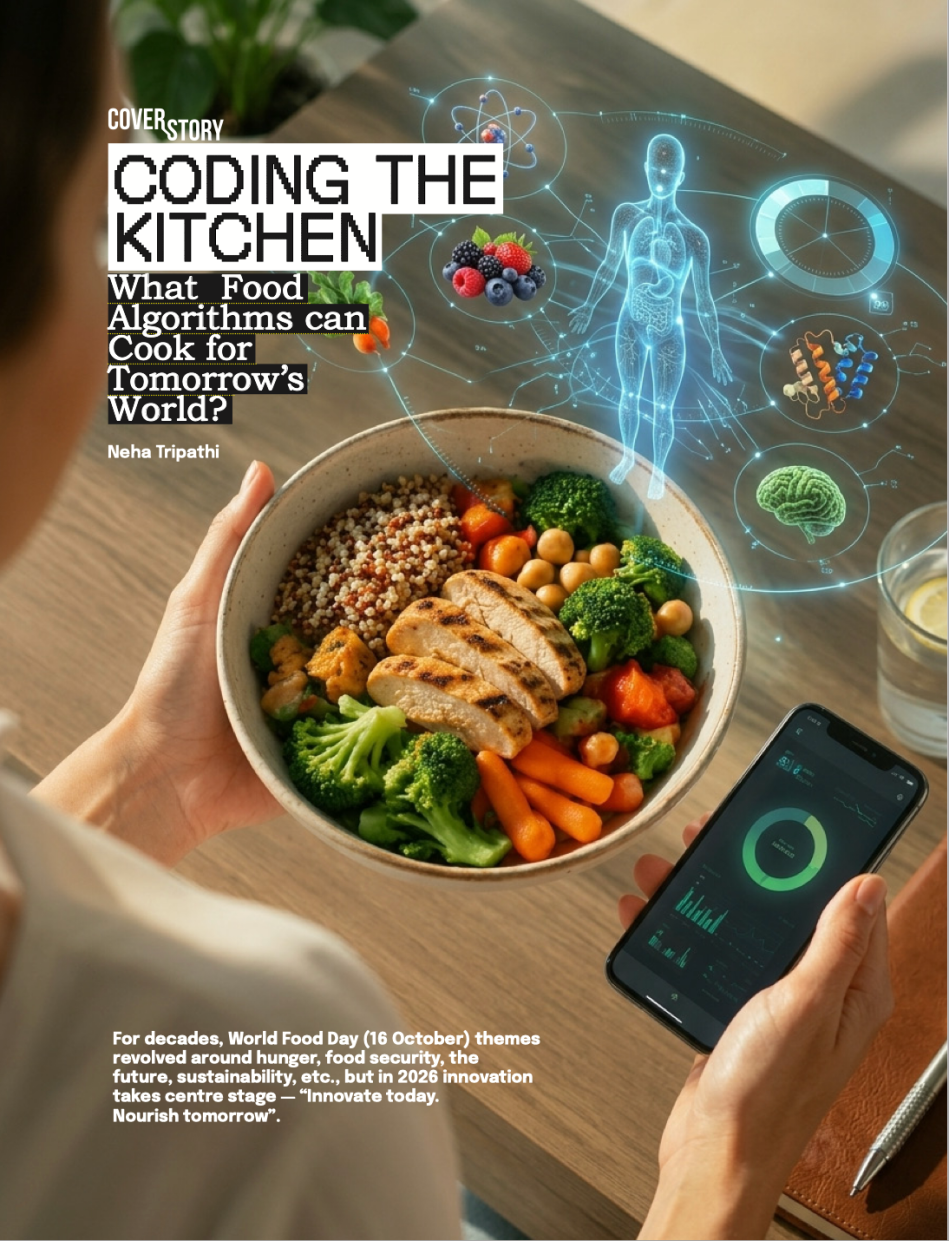


Can Algorithms Feed a Nation? AI and India’s Food Future
It’s 2050. Your AI assistant wishes you good morning with a mug of coffee. You leave the bed only to move to the kitchen for your breakfast preparations. You enter the kitchen and the lights automatically brighten. The fridge welcomes you with a beep and informs you of its contents – what’s nearing expiry date, what’s stale and what’s fresh. Smart countertops start displaying recipes matching your health goals. The chopper wonders what it will get today for chopping? Ovens and cooktops start adjusting time and temperature. Robotic assistance handle cooking, stirring and cleaning. And you are the BOSS. Just managing everything with commands and a coffee mug in your hands.
Food is prepared and now you are on the dining table waiting for the AI robots to serve you, rather feed you. This moment reminds me of the iconic scene from the 1936 satirical classic masterpiece ‘Modern Times’. Charlie Chaplin is sitting on the dining table shocked to see the Billows Feeding Machine. The machine tries to feed him soup, corn on the cob and cake. This is the imagination in 1936 which we foresee as our daily routing in 2050. But in 1936, the machine malfunctions and starts attacking and messing up character’s face. The problem was the mechanical parts of the machine going too fast, shoving food onto the face.
When your plate becomes data
90 years later, today, we are in 2026. AI has made eating visible and measurable. AI systems are already learning to recognise food, estimate nutrition and guide dietary choices. In future these capabilities may become part of intelligent kitchen assistants. Your daily allowance is personalised using factors such as age, height, weight, gender and activity level. AI can easily suggest to increase or decrease the quantity and quality of food. It can alarm you about the usage of too much oil in your meal and at the same time it can appreciate you for having balanced, nutrition rich food.
Even there are apps which can turn the static diet chart into the dynamic food tracker. Yesterday the diet chart was pinned to your refrigerator door, but todays’s kitchen may has a traffic signal for your appetite. The app may not only tell you what is on your plate but also guide you what to take off from the plate.
As you photograph breakfast, lunch and dinner, the bar in the app keeps moving towards the daily limit. If you have already consumed 75% of your daily allowance, the app recommends what you can eat next, still remaining within your calorie limit. The calorie tracker is deliberately colour coded. Green, Yellow, Orange… visually it keeps telling you how much you have already eaten and when you need to control yourself. Even the system could eventually suggest – remove these two items from your plate and you will remain within your limit.
What exactly is a food algorithm ?
The personalised nutrition information is based on algorithm. By definition, algorithms are sets of rules that help computers make choices. Food algorithm is a set of computer instructions used by delivery apps, recipe sites or nutrition tools to process data and make decisions. Sp, every recommendation we receive today already runs on algorithm. The next step is when algorithms move from suggesting restaurants to understanding food itself.
How experts see this ? A pioneer of Computational Gastronomy and Food AI in India, Prof. Ganesh Bagler explains – “Food is perhaps one of humanity’s oldest technologies, but surprisingly, it remains one of the least computationally understood. Today, we are beginning to change that with the advent of Computational Gastronomy. By converting recipes, ingredients, flavours, nutrients and culinary practices into structured data, AI can begin to understand food as a complex system. The algorithms we develop today can help us answer questions that traditionally required enormous amounts of experimentation :
This becomes particularly important in countries like India, where food must simultaneously address nutrition, affordability, cultural diversity and sustainability. I therefore see AI not simply as a technology for generating recipes, but as an intelligence layer for the entire food ecosystem–from agriculture and food formulation to personalized nutrition and public-health programmes. Tomorrow’s food will increasingly be designed with computation, but its ultimate success will still be determined by something profoundly human: whether people actually enjoy eating it.”
As they say, great minds think alike. Renowned nutrition therapist and wellness consultant and also national executive member of Indian Dietetic Association, Neelanjana Singh opines – “Even if you get 100% perfect diet, you get the macro nutrients right, the micronutrients right, you get all the food items with the right glycemic index, the right combinations, the right ratios. But for the human, it is very important to also enjoy the food. And that enjoyment comes from texture variations. Somebody might like more coarse kind of grain. Somebody might like very fine grain. So, the texture, the flavours and all these food aversions need to be taken care of. And to address all these factors, you need the human interface. And just getting the perfect ratios is unlikely to guarantee success of a planned diet.”
At the same time, there is a battle between the algorithm of ordering foods and the algorithm of nutrition. Nutrition algorithm is under scrutiny. To address personal nutrition, the data related to choices, requirements, taste, needs have to be shared. This means personal data will become central. The machines to learn the desired person’s palette. This leads to an emerging web of questions on – Who owns the data generated through continuous food tracking? How data privacy issue will be addressed? How to ensure that this data usage will be for benefit only? How to anticipate if anyone’s data will be used or misused? These questions are far sighted but have to be answered today for a safe and sound tomorrow.
The algorithm hidden inside our kitchen
Kitchens have followed algorithms and patterns for centuries. The spices, ingredients, cooking methods, food items, all follow patterns. Every cook has his/her own secrets. Some are obvious, others are hidden. As per today’s systems and analysis the normal and secret recipes are supposed to follow a mathematical pattern. AI is now helping scientists uncover these invisible rules of cooking.
In a recent study by Indraprastha Institute of Information Technology Delhi, an attempt is made to uncover hidden patterns in culinary traditions. Researchers analysed more than 1,18,000 recipes spanning 26 cuisines from around the world using computational approaches. Every recipe was broken down into its core building blocks – ingredients, cooking steps, kitchen tools – before examining them for recurring structures and overlaps.
The study reveals – just like languages have grammar, food traditions may also have an underlying grammar of ingredients and cooking methods. For example – a handful of commonly used words dominate everyday communication, while rarer words appear occasionally. It is just like ‘the’ and ‘a’ being used frequently in almost all sentences, salt, oil, onion, garlic occur repeatedly across recipes in the cuisine world. Meanwhile rare spices and herbs are used sparingly. Moreover, every new recipe introduces some unfamiliar ingredients, but over time, the same ingredients are reused in different countries.
Cooking feels like a creative art but it has too much maths underlying the concept. Reusing familiar ingredients, modifying existing combinations, adding a distinctive ingredient that changes flavour perception help create new recipes. AI has the capability to identify patterns in cooking that makes cuisines different. By learning the accumulated intelligence of thousands of kitchens AI is utilising the recipe database and machine learning models. Researchers have developed systems that can generate novel recipes by learning patterns from existing recipes.
When we cook, simple recipes have simple constitution, but adding a single distinctive ingredient can change the flavour, taste and perception of the dish for many. This is not making cooking complex, but making it predictable. There are 3 simple principles – reused popular ingredients, stay within cultural and flavour constraints and modify existing teaches rather than inventing entirely new ones.
25,595
Flavour molecules mapped to understand why ingredients taste the way they do.
1,18,000+
Recipes analysed to uncover hidden patterns in global cuisines.
23,500+
Ingredients studied to decode culinary relationships.
68,005
Indian food images used to train AI models for food recognition.
27 million
Biomedical abstracts analysed to explore links between food and health.
Planning nutrition the AI way
Food is the only thing in this whole universe which goes inside your body, becomes part of it and makes an impact on the next generation. The effect of food is something you may realise only over a very long period of time. Maybe in today’s world it takes 80 to 100 years to understand some effects. With AI, it might become 30 or 40 years, but it will still take time. So, the best minds must document their knowledge and teach AI so that a common person can get the best possible result.
President of Indian Federation of Culinary Associations Chef Manjit Singh Gill uses AI as assistant and not as intelligence. He foresees – “The machines will work. Technology will be fully integrated into it, and technology will help us understand food much better. AI, with the learning that people give it through their experiences and knowledge, will definitely optimise personal nutrition. But for now, even today, if I want to understand my personal nutrition, it is a little difficult. Even the best nutritionists ask you to document everything you eat every day, at what time and how much, for a week or ten days. You have to create that data. Then they are able to analyse it and tell you exactly what you should practise. AI will be able to do that. But you have to give it the inputs: your health, age, lifestyle, activities, the climate you live in, and even your individual metabolic needs. All these things matter. If there is something wrong in the information you give, the data is biased or incomplete, result will also be wrong. The response from AI will also be wrong. That is not the fault of AI. It depends on what information you give it.”
No doubt, the AI generated hyper personalised diets are very exciting and valid concept. It is believed that they can soon potentially use information from a person’s DNA genetic variants and gut microbiome. That biological blueprint can certainly be useful in planning nutrition. But the destination is far off.
Neelanjana Singh differs saying – I find DNA analysis and the gut microbiome analysis very fascinating, but it’s so incomplete. So I don’t really use that data. There are so many genetic variations, but very few of them have been studied. No clear picture on how they have influenced the metabolism. So it is a very small percentage that has been studied. And you really can’t have the entire picture.”
Chef Gill believes “Food science is still evolving. Over the last few decades, new information about fats, oils and diets has changed many earlier assumptions. This constant evolution shows why food decisions need both scientific evidence and cultural beliefs.”
So, We all understand that the gut microbiome is not something that is fixed. it is changing every day based on what you are eating, how much you are sleeping or how stressed you are. So just getting one piece of information on the gut microbiome may not really give the entire picture but when the nutritionist plans so you get a more holistic plan based on the client’s entire living experience which includes environmental, cultural and psychological factors. So although this hyper personalized diet, the AI generated ones are exciting and valid but still right now incomplete.
Will tomorrow’s food taste better ?
While struggling everyday for what to cook, another important aspect is how to make it tastier than before. The family when comes together at the dinner table, should not make faces, rather be inquisitive about the different flavours and tastes in today’s meal. So, adding new recipes is a very good idea. And machines have already worked on millions of recipes options. For now they are experimenting with different permutations and combinations of already existing food items in different categories.
The innovations being done today will change the nourishment factor for our upcoming generations. Bringing in alternative proteins, plant based foods, fermentation, harnessing modern tools for efficient agriculture, developing long standing varieties of crops, combining old and new methods, safeguarding natural resources for future generations, food formulations will help scientists test thousands of possible ingredients virtually with AI.
AI generated recipes, ingredient substitutions and cooking assistants can make clever combinations. They can solve the everyday mess of every household – what to cook, but genuinely delicious food is a parameter, still believed that humans will decide in any era. Also, we can’t predict the future, if the everyday chaos of what to cook will be solved or more messed up with increasing number of options.
Chef gill gives an example of ‘Murg Makhani’. He emphasises that everything is good for health. It just depends on how it is cooked and the quantity you eat. For Murg Makhani, you need to add cream. We all know this cream is not good for health. But it is very important for taste. Cream is lying in an open bowl at high temperature in a kitchen and then it has to be cooked. All this is dangerous for your health. So, there are techniques to save your health. The cream can be produced from the makhanas. You can make white liquid from makhanas and then add it in place of dairy cream. I am saying fresh makhanas give you light cream if you make it. It is very similar taste, texture, colour and presentation of the dish. People will not be able to catch the taste and it will be good for their health.” Such experiments are happening at human level. Imagine the level of AI, what all it can experiment with our taste and health.
In various interactions with me over the years, Prof Bagler has been consistent in saying Indian cuisine has its own fingerprint and spices are one of the most important reasons for this uniqueness. Change one spice in an Indian recipe and you may change the entire flavour pairing pattern of the dish.” He opines – “Before asking whether AI generated recipe tastes good, we can ask a simpler question : Can an expert chef distinguish an AI made recipe from a real recipe. Ultimately the recipe has to enter the kitchen, it has to be cooked and tasted.” Another aspect is that, for now anything that is AI predicted or generated can be used as a guide book. Until it has ben tried tested and validated, chefs will not rely on it one hundred percent.
Can AI preserve food heritage ?
In a country where every meal includes memories, emotions, culture, religion, tradition and above all a family, no recipes are actually written down. It is all on intuition of the person cooking and the taste palette developed over the years. In Indian homes, recipe does not mean ingredients list. If one has to note down a recipe, it will be written as :
Recipe : Dal
But when a mother is cooking at home, she will put everything as per her intuition without measurement. Still the dal is cooked perfectly. This human touch is very important because for Indian homes food is not just another task, it is like prayer and worship.
Prof. Ganesh Bagler has been working for more than a decade on Computational Gastronomy and he strongly believes that “Food is deeply connected with culture, family, history and emotion.” Grandmother’s recipes are immortal. The secrets are never intentionally revealed but are taken down in family hierarchy. For example my grandmother, used to roast cumin on low flame, crush ginger instead of chopping it, add garam masala after the the dish is partially cooked, add salt with hands and not spoons, not stir the vegetables too much while cooking, etc. She had her own habits and reasons for the same.
So, when it comes to AI, it must observe indian cooking style without getting confused as it varies from home to home and person to person. Same ingredients added at different times and in different veggies give unique flavours. AI has to learn a lot when it comes to Indian cuisine, like –
But will AI chefs be able to capture the intuition and decode the same taste? Will it be able to process the feedback on its preparations? Like someone says – coriander powder is needed to fix the taste or may be some more amachur is needed to balance the bitterness. This is something the scientists are working on, and would look upto in more details in coming years. Also when we talk about algorithm and systems, AI has the responsibility of preserving the food heritage of Indian homes. Here, AI is not only supposed to digitise everything or create thousands of data points. AI is observing someone cooking repeatedly, his/her habits and style, mark the actions and convert them into data and numbers.
This way, AI may some day master the grandmother’s dal recipe perfectly. But it has only preserved the method while the memory still belongs to that person. Although, with this trend, such systems can preserve regional recipes, old cooking technique, forgotten grains, tribal foods, seasons dishes and oral culinary traditions.
Will AI make the food too technical ?
The Food AI industry is booming. It will definitely feed tomorrow’s world in a completely unexpected manner. As Prof. Bagler puts it – “By 2050, the global population is expected to touch 9.7 billion posing a serious food security challenge. By then, I expect AI to change not only how food is produced, but increasingly what appears on our plates. Today, most food products are designed for populations. In the future, food could increasingly be designed for individuals–taking into account age, lifestyle, nutritional requirements, health goals, culture, affordability and, importantly, personal taste. AI could also dramatically expand our ingredient vocabulary. Instead of relying heavily on a relatively small number of globally dominant crops and proteins, computational tools could help rediscover underutilized grains, legumes, plants and traditional ingredients, and determine how to combine them into nutritious and desirable foods. Alternative proteins and sustainable ingredients will become much easier to formulate when algorithms can predict flavour, texture, nutrition and consumer acceptance before expensive physical experimentation begins. But I don’t think AI will homogenize food or replace cooks. Ideally, it will do the opposite. By learning from humanity’s enormous culinary diversity, AI can help preserve, reinterpret and expand it. By 2050, therefore, we may move from asking, “What food is available for me?” to asking, “What food should be designed for me and for the planet?”
Chef Gill opines – “The plate of 2050 may be very technologically intelligent. But it must remain ecologically responsible, culturally rooted and human-centred. At this moment, we cannot ignore that. Technology should optimise the plate, but it should not erase its identity. That is the thought, at least till now. I cannot say exactly what will happen 20 years from now, but these things will definitely happen, with some ifs and buts. We can guess what may happen in the future with an optimistic and positive approach. It all depends on how much we feed AI and how much we make AI more intelligent. That is what Prof. Bagler and other scientists are working on. But people like us have to use, first-hand, whatever changes are coming from AI and give our experiences back to the scientists. It is a complete chain. We give them our knowledge and experience, and they put it into the system.”
Between all this, we have to understand that Mother Earth is a living thing. It is not dead. It gives us energy and life. If we do something wrong, the nature makes corrections. We are seeing extreme events every now and then. But dont forget the beauty of nature. On the same land, in different climates, we grow different plants, flavours, vegetables, flowers and colours. Everything comes from the same earth.
Technology is booming. We all have to speed up to match with the technological advancements. Same is the case with innovation in food sector. Algorithms will not replace farmers, cooks or human judgements. May be one day AI can tell us that if a particular food is grown or cooked in a particular way, there can be 100 percent utilisation and no wastage. Still the real promise is to help people produce, distribute and use food more intelligently. So the next food revolution will not be on farms or in restaurants, but in the algorithms that will transform the way human eat today and will eat tomorrow.
Share this: