How ancient civilizations turned the night sky into a tool for survival, navigation, memory, and power ?
Across continents and timelines, civilizations that never met each other developed a surprisingly deep understanding of the sky. From the Mayas in Central America to the Indians, Chinese, Egyptians, Greeks, and Vikings, the night sky became a central reference point for life.
This was not because of cultural exchange. It was because of a shared constraint. Human beings everywhere faced the same fundamental questions:
• How to measure time?
• How to move across unknown spaces?
• How to predict change?
And the only stable, visible, and repeatable system available was the sky. What emerged was not just astronomy. It was a form of applied intelligence shaped by necessity.
1. The Sky as a Calendar: Time Before Timekeeping
In pre-industrial societies, time was not abstract. It was directly tied to survival. Agricultural societies especially depended on accurate timing for sowing, harvesting, and storage. Without clocks or printed calendars, civilizations turned to the most predictable cycles available:
• The Sun established the rhythm of day and season
• The Moon created a visible monthly cycle
• The Stars provided long-term annual markers
For example, the appearance of specific stars just before sunrise, known today as heliacal rising, was used in multiple cultures to mark seasonal transitions. In ancient Egypt, the heliacal rising of Sirius was associated with the flooding of the Nile, a critical agricultural event.
What is important here is not the observation itself, but the discipline of observation over generations. Patterns were not discovered in a single lifetime. They were refined, corrected, and transmitted across centuries. The sky became a living calendar, not written, but remembered and verified continuously.
2. The Sky as Navigation: Direction Without Instruments
Contrary to modern assumptions, long-distance navigation is not a recent development. It existed in highly sophisticated forms long before compasses and maps. Different civilizations developed independent yet equally effective systems:
• Polynesian navigators memorized star paths and ocean patterns to cross vast stretches of the Pacific
• Viking explorers used solar positioning and horizon-based cues for navigation in northern seas
• Indian and Arab traders relied on constellations and celestial positions for maritime trade routes
What makes this remarkable is that navigation was not dependent on devices, but on cognitive mapping. The sky functioned as a rotating coordinate system. Instead of carrying maps, navigators internalized them.
This required:
• Acute observational skills
• Long-term memory training
• Continuous calibration with real-world movement
Navigation, therefore, was not just a technical skill.
It was a mental discipline rooted in astronomy.
3. Pattern Recognition: The Cognitive Engine Behind Astronomy
While the sky is physically uniform across the Earth, human interpretation of it varies dramatically. This difference is not due to lack of knowledge, but due to the way the human brain processes visual information.
The brain is naturally wired to:
• Detect patterns
• Connect points into shapes
• Convert shapes into stories
This cognitive tendency led to the formation of constellations, but not as fixed scientific constructs. Instead, they became cultural overlays on a shared visual field.
• Greek astronomy identified Orion as a hunter
• Indian traditions saw similar star patterns as Mriga (a deer)
• Chinese astronomy developed an entirely separate system of celestial divisions
These differences highlight an important principle:
The sky provided the data, but culture provided the interpretation framework. Storytelling served a functional purpose. It transformed abstract star positions into memorable narratives, enabling accurate transmission of knowledge across generations without written systems.
4. Astronomy as Authority: Knowledge, Power, and Order
At a certain stage, astronomical knowledge moved beyond survival and entered the domain of power. Those who could interpret celestial events gained social and political significance. This included:
• Predicting eclipses
• Structuring calendars
• Determining dates for rituals, festivals, and agricultural cycles
In many civilizations, this knowledge was concentrated among priests, scholars, or royal advisors. The ability to predict rare or dramatic events, such as eclipses, created a perception of control over natural phenomena. This translated into authority.
Astronomy thus became:
• A tool for governance
• A framework for religious timing
• A system for maintaining social order
It is important to note that this was not manipulation in the modern sense. It was a natural consequence of knowledge asymmetry. Those who understood the sky better could guide those who did not.
5. Convergent Intelligence: Similar Solutions Without Contact
One of the most compelling aspects of ancient astronomy is that similar systems emerged independently across civilizations. This phenomenon can be understood through the concept of convergent intelligence. Three factors remained constant globally:
• The input: the same sky visible to all
• The problem: need for timekeeping, navigation, and prediction
• The method: long-term observation and pattern recognition
When these conditions are identical, it is natural for similar solutions to arise, even in isolation.
This explains why:
• Multiple civilizations developed lunar and solar calendars
• Navigation techniques based on stars appeared in different parts of the world
• Astronomical alignments were incorporated into architecture (e.g., pyramids, temples)
These were not coincidences. They were independent responses to a shared environment.
6. A Shift in Relationship: From Dependence to Detachment
Modern society has access to highly precise astronomical data through satellites, telescopes, and digital systems. However, the relationship with the sky has fundamentally changed.
For ancient civilizations:
• The sky was immediate, functional, and necessary
For modern society:
• The sky is distant, abstract, and often ignored
Time is now measured by devices, not celestial cycles. Navigation is outsourced to GPS, not memory. As a result, the observational discipline that once defined human interaction with the sky has weakened.
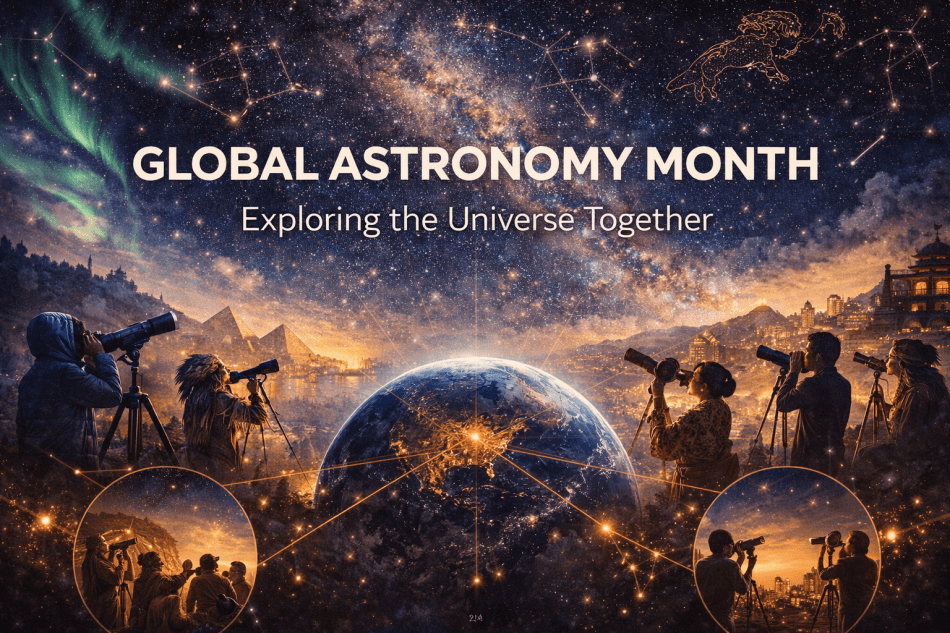
Why Global Astronomy Month Still Matters Today ?
Global Astronomy Month is often seen as a celebration of telescopes, planets, and distant galaxies. But its deeper significance lies elsewhere. It is a reminder of something humanity once did naturally. Across civilizations, the sky was not a subject. It was a system.
A calendar to plan life, a compass to move across unknown spaces, a framework to understand change.Today, that relationship has shifted. We still study the universe with far greater precision, but we rarely observe it directly.
Time comes from screens, direction from GPS, and seasons from notifications. The sky has moved from being a daily reference to a distant curiosity. Global Astronomy Month quietly invites a reversal of this shift. Not by asking people to become scientists, but by encouraging a simple act – to look up, notice patterns, and reconnect with a system that once guided all human life.
In that sense, this month is not just about astronomy. It is about restoring a form of awareness that existed across Mayas, Indians, Chinese, Greeks, and many others. Because the sky has not changed. Only our attention to it has.
The Sky Was Not Above Them, It Was Within Their System
Ancient astronomy was not an isolated field of study. It was integrated into daily life, decision-making, and cultural systems.
The sky functioned as:
• A calendar for time
• A compass for movement
• A framework for storytelling
• A source of authority
• A shared reference for independent innovation
What connects all civilizations is not just that they observed the sky. It is that they built systems of understanding around it. In that sense, astronomy was humanity’s first universal language, not spoken in words, but in patterns, memory, and continuity.

 NehaScope
How ancient civilizations turned the night sky into a tool for survival, navigation, memory, and power ?
Across continents and timelines, civilizations that never met each other developed a surprisingly deep understanding of the sky. From the Mayas in Central America to the Indians, Chinese, Egyptians, Greeks, and Vikings, the night sky became a central reference point for life.
This was not because of cultural exchange. It was because of a shared constraint. Human beings everywhere faced the same fundamental questions:
• How to measure time?
• How to move across unknown spaces?
• How to predict change?
And the only stable, visible, and repeatable system available was the sky. What emerged was not just astronomy. It was a form of applied intelligence shaped by necessity.
1. The Sky as a Calendar: Time Before Timekeeping
In pre-industrial societies, time was not abstract. It was directly tied to survival. Agricultural societies especially depended on accurate timing for sowing, harvesting, and storage. Without clocks or printed calendars, civilizations turned to the most predictable cycles available:
• The Sun established the rhythm of day and season
• The Moon created a visible monthly cycle
• The Stars provided long-term annual markers
For example, the appearance of specific stars just before sunrise, known today as heliacal rising, was used in multiple cultures to mark seasonal transitions. In ancient Egypt, the heliacal rising of Sirius was associated with the flooding of the Nile, a critical agricultural event.
What is important here is not the observation itself, but the discipline of observation over generations. Patterns were not discovered in a single lifetime. They were refined, corrected, and transmitted across centuries. The sky became a living calendar, not written, but remembered and verified continuously.
2. The Sky as Navigation: Direction Without Instruments
Contrary to modern assumptions, long-distance navigation is not a recent development. It existed in highly sophisticated forms long before compasses and maps. Different civilizations developed independent yet equally effective systems:
• Polynesian navigators memorized star paths and ocean patterns to cross vast stretches of the Pacific
• Viking explorers used solar positioning and horizon-based cues for navigation in northern seas
• Indian and Arab traders relied on constellations and celestial positions for maritime trade routes
What makes this remarkable is that navigation was not dependent on devices, but on cognitive mapping. The sky functioned as a rotating coordinate system. Instead of carrying maps, navigators internalized them.
This required:
• Acute observational skills
• Long-term memory training
• Continuous calibration with real-world movement
Navigation, therefore, was not just a technical skill.
It was a mental discipline rooted in astronomy.
3. Pattern Recognition: The Cognitive Engine Behind Astronomy
While the sky is physically uniform across the Earth, human interpretation of it varies dramatically. This difference is not due to lack of knowledge, but due to the way the human brain processes visual information.
The brain is naturally wired to:
• Detect patterns
• Connect points into shapes
• Convert shapes into stories
This cognitive tendency led to the formation of constellations, but not as fixed scientific constructs. Instead, they became cultural overlays on a shared visual field.
• Greek astronomy identified Orion as a hunter
• Indian traditions saw similar star patterns as Mriga (a deer)
• Chinese astronomy developed an entirely separate system of celestial divisions
These differences highlight an important principle:
The sky provided the data, but culture provided the interpretation framework. Storytelling served a functional purpose. It transformed abstract star positions into memorable narratives, enabling accurate transmission of knowledge across generations without written systems.
4. Astronomy as Authority: Knowledge, Power, and Order
At a certain stage, astronomical knowledge moved beyond survival and entered the domain of power. Those who could interpret celestial events gained social and political significance. This included:
• Predicting eclipses
• Structuring calendars
• Determining dates for rituals, festivals, and agricultural cycles
In many civilizations, this knowledge was concentrated among priests, scholars, or royal advisors. The ability to predict rare or dramatic events, such as eclipses, created a perception of control over natural phenomena. This translated into authority.
Astronomy thus became:
• A tool for governance
• A framework for religious timing
• A system for maintaining social order
It is important to note that this was not manipulation in the modern sense. It was a natural consequence of knowledge asymmetry. Those who understood the sky better could guide those who did not.
5. Convergent Intelligence: Similar Solutions Without Contact
One of the most compelling aspects of ancient astronomy is that similar systems emerged independently across civilizations. This phenomenon can be understood through the concept of convergent intelligence. Three factors remained constant globally:
• The input: the same sky visible to all
• The problem: need for timekeeping, navigation, and prediction
• The method: long-term observation and pattern recognition
When these conditions are identical, it is natural for similar solutions to arise, even in isolation.
This explains why:
• Multiple civilizations developed lunar and solar calendars
• Navigation techniques based on stars appeared in different parts of the world
• Astronomical alignments were incorporated into architecture (e.g., pyramids, temples)
These were not coincidences. They were independent responses to a shared environment.
6. A Shift in Relationship: From Dependence to Detachment
Modern society has access to highly precise astronomical data through satellites, telescopes, and digital systems. However, the relationship with the sky has fundamentally changed.
For ancient civilizations:
• The sky was immediate, functional, and necessary
For modern society:
• The sky is distant, abstract, and often ignored
Time is now measured by devices, not celestial cycles. Navigation is outsourced to GPS, not memory. As a result, the observational discipline that once defined human interaction with the sky has weakened.
Why Global Astronomy Month Still Matters Today ?
Global Astronomy Month is often seen as a celebration of telescopes, planets, and distant galaxies. But its deeper significance lies elsewhere. It is a reminder of something humanity once did naturally. Across civilizations, the sky was not a subject. It was a system.
A calendar to plan life, a compass to move across unknown spaces, a framework to understand change.Today, that relationship has shifted. We still study the universe with far greater precision, but we rarely observe it directly.
Time comes from screens, direction from GPS, and seasons from notifications. The sky has moved from being a daily reference to a distant curiosity. Global Astronomy Month quietly invites a reversal of this shift. Not by asking people to become scientists, but by encouraging a simple act – to look up, notice patterns, and reconnect with a system that once guided all human life.
In that sense, this month is not just about astronomy. It is about restoring a form of awareness that existed across Mayas, Indians, Chinese, Greeks, and many others. Because the sky has not changed. Only our attention to it has.
The Sky Was Not Above Them, It Was Within Their System
Ancient astronomy was not an isolated field of study. It was integrated into daily life, decision-making, and cultural systems.
The sky functioned as:
• A calendar for time
• A compass for movement
• A framework for storytelling
• A source of authority
• A shared reference for independent innovation
What connects all civilizations is not just that they observed the sky. It is that they built systems of understanding around it. In that sense, astronomy was humanity’s first universal language, not spoken in words, but in patterns, memory, and continuity.
Share this: