You are driving along Mumbai’s Coastal Road, the sea on one side, the skyline on the other. The radio is off. The windows are rolled up to keep out the traffic hum.
And then, without warning, your car begins to play “Jai Ho.”
Not from your phone. Not from a hidden speaker. Not from anywhere you can see.
The sound rises through the tyres, travels through the suspension, hums through the chassis and fills the cabin. For a few seconds, the asphalt beneath you turns into an instrument.
This is not a marketing gimmick. It is geometry. It is vibration. It is physics translated into pavement.
A Road That Sings
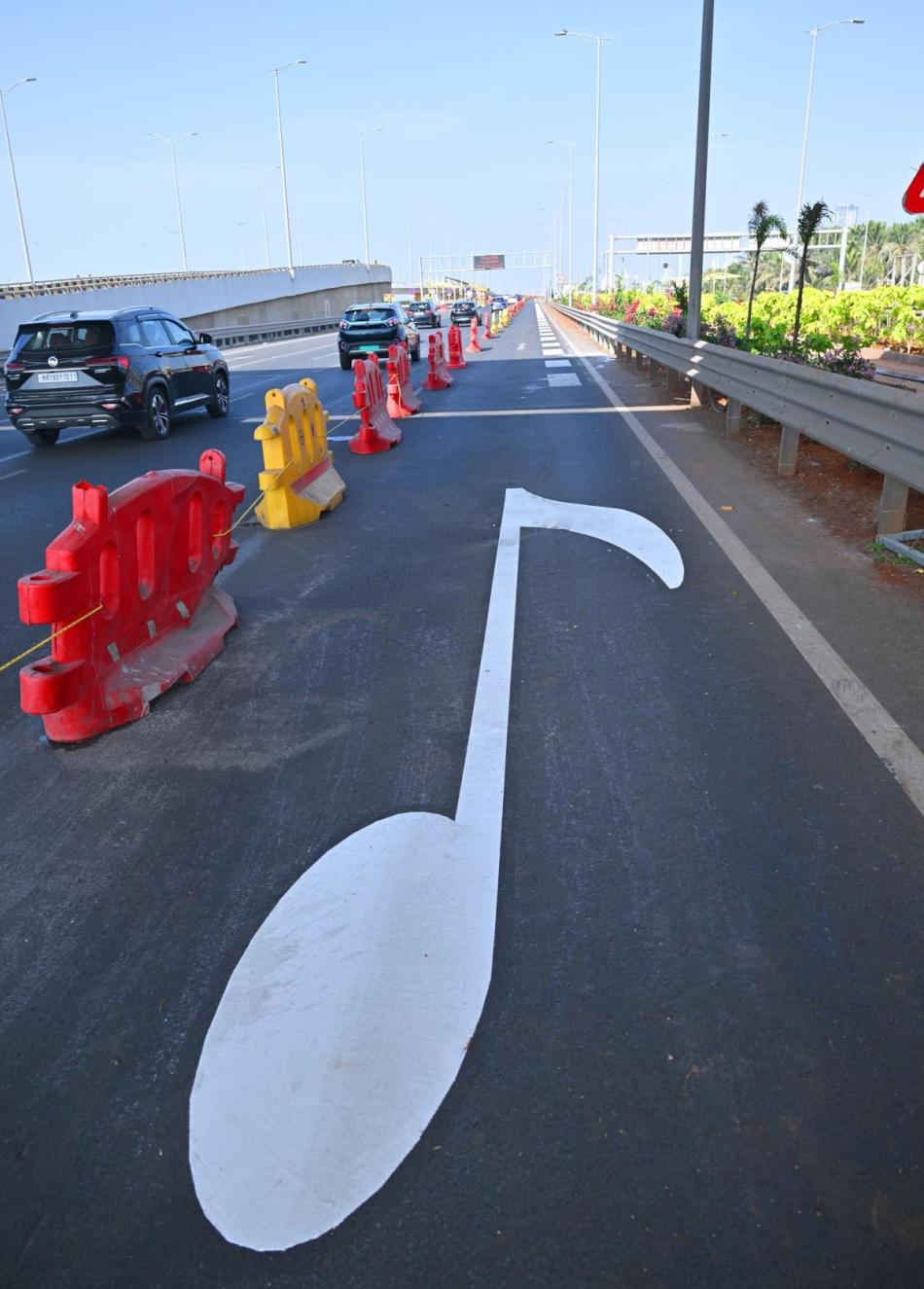
On a specially engineered stretch of the Mumbai Coastal Road, grooves carved into the asphalt have been calibrated so that, at around 70 to 80 kilometres per hour, the rhythm of your wheels becomes music. India’s first musical road is not just a novelty. It is an experiment in how infrastructure can communicate — not with signs or signals, but with sound.
The tune? “Jai Ho” from Slumdog Millionaire , made audible not through speakers, but through the physics of tyre vibration and road design.
Motorists traveling at the right speed along a 500-metre stretch on the northbound lane from Nariman Point to Worli will hear the melody as tyres roll over specially spaced grooves in the surface.
Where It Is ?
The musical section is on the Mumbai Coastal Road, a major urban expressway built by the Brihanmumbai Municipal Corporation (BMC) to ease inner-city traffic.
The grooves are placed just after the Worli tunnel exit on the lane adjacent to the divider. When vehicles pass over them at the recommended speed, the vibrations produce a recognizable melody , audible inside the vehicle.
How Does a Road “Play” Music? ?
The concept of a musical road is not new globally. Around the world , in countries such as Japan, the United States, Taiwan, and China , roads have been designed to produce sound by varying the spacing of grooves in the pavement.
The Physics Behind the Song
This is not digital playback. It is mechanical frequency design.
1. Groove Spacing Determines Pitch
Each groove acts like a tiny vibration trigger.
When a tyre rolls over a groove:
• It drops slightly into the indentation.
• It rises back onto the flat surface.
• That up-down motion creates vibration.
• Vibration generates sound waves.
Now here’s the key:
The distance between grooves determines how frequently these vibrations occur per second. That frequency becomes the musical note.
Top View (Spacing Pattern)
|—-d—-|—-d—-|—-d—-|—-d—-|
d = Distance between grooves
The Core Relationship
Frequency (Hz) ≈ Vehicle Speed ÷ Groove Spacing
If:
• Speed = 72 km/h
• Groove spacing = X meters
Then the tyre hits grooves at a frequency that corresponds to a musical note.
Closer grooves → Higher frequency → Higher pitch
Wider spacing → Lower frequency → Lower pitch
Let’s assume:
- Speed = 72 km/h→ 72 km/h = 20 meters per second
If engineers want a note around 400 Hz (roughly a musical pitch near G4):
They calculate spacing as:
d = V ÷ Frequency
d = 20 ÷ 400
d = 0.05 meters
d = 5 cm
So grooves would be spaced approximately 5 cm apart for that note at that speed.
Change the note → Change the spacing.
That’s how melody is encoded.
2. How “Jai Ho” Is Converted into Road Geometry ?
A melody is a sequence of musical notes.
Each note has:
• A specific frequency (in Hertz)
• A duration (how long it plays)
A song is not one frequency.
It is a sequence:
Note 1 → spacing d₁
Note 2 → spacing d₂
Note 3 → spacing d₃
So the road looks like:
|–d1–|–d1–|–d1–|–d2–|–d2–|–d3–|–d3–|–d3–|
Each cluster represents a musical note held for a certain duration.
To encode “Jai Ho”:
- Engineers calculate the frequency of each note
- Convert frequency into groove spacing
- Adjust spacing for the chosen optimal speed
- Repeat pattern in sequence
So instead of sheet music on paper, you get sheet music translated into asphalt spacing. It’s literally civil engineering meets music theory.
3. Why 70–80 km/h?
Because pitch depends on speed.
If the road is tuned for 75 km/h:
• At 60 km/h → Notes sound lower and distorted
• At 90 km/h → Notes sound higher and rushed
• At 75 km/h → Melody aligns correctly
This means:
The road subtly encourages drivers to maintain a steady speed to “hear it properly.” That’s behavioural design embedded into infrastructure.
4. Why You Hear It Inside the Car ?
The sound is primarily transmitted through:
• Tyre vibration
• Suspension system
• Car body resonance
Unlike loud external noise, the melody is often more audible inside the vehicle because:
• The car cabin amplifies certain vibration frequencies.
• Road noise combines rhythmically.
• The enclosed space enhances perception.
This is similar to how rumble strips warn drivers , except here the spacing is tuned musically.
Where the Sound Is Heard
The vibration travels:
Tyre → Suspension → Vehicle chassis → Cabin air → Passenger ears
The car acts like a resonance chamber, making the rhythm audible inside.
5. Groove Depth and Width Matter Too
Pitch is controlled by spacing, but:
• Groove depth affects vibration intensity.
• Groove width affects contact time.
• Surface material affects resonance.
Too shallow → No clear sound
Too deep → Excessive noise and tyre wear
So it’s a calibrated balance.
6. Is It Just a Fancy Rumble Strip?
Technically , yes. But engineered with precision.
Traditional rumble strips:
• Uniform spacing
• Designed for alertness
Musical road:
• Variable spacing
• Designed for musical pitch sequence
The engineering principle is the same. The execution is refined.
Musical Roads , A Global Phenomenon
Musical road technology has been used internationally for decades:
• Japan: Melody Roads play traditional songs and village tunes.
• United States: A famous musical road in Lancaster, California played part of the William Tell Overture.
• China: Roads produce national or folk songs through engineered grooves.
These installations serve multiple purposes , from tourism and driver engagement to speed awareness and road safety.
Why This Matters
- Driver Behaviour – The musical effect is not just whimsical. Because it only works at a specific speed, it incentivises drivers to maintain a consistent pace, similar to how rumble strips encourage attention.
- Safety and Experience – While explicit safety data has not yet been published for the Mumbai stretch, similar projects overseas have been linked to: Better speed compliance, Enhanced driver engagement, Reduced monotony on long drives.
What’s Next
The Mumbai project’s inauguration by Maharashtra leadership places India on the map of countries experimenting with infrastructure that communicates through sound.
Future directions media and experts may explore include:
• Whether the sound affects nearby residents ?
• How long the effect lasts as grooves wear down ?
• The trade-off between engineering precision and maintenance
Unlike electronic signage or speaker systems, musical roads are a blend of civil engineering and physics , a literal translation of vibration into melody. As India’s first such installation takes shape in Mumbai, it opens a new chapter in how infrastructure can serve not just function, but experience.
(Photo Credit : BMC)

 NehaScope
You are driving along Mumbai’s Coastal Road, the sea on one side, the skyline on the other. The radio is off. The windows are rolled up to keep out the traffic hum.
And then, without warning, your car begins to play “Jai Ho.”
Not from your phone. Not from a hidden speaker. Not from anywhere you can see.
The sound rises through the tyres, travels through the suspension, hums through the chassis and fills the cabin. For a few seconds, the asphalt beneath you turns into an instrument.
This is not a marketing gimmick. It is geometry. It is vibration. It is physics translated into pavement.
A Road That Sings
On a specially engineered stretch of the Mumbai Coastal Road, grooves carved into the asphalt have been calibrated so that, at around 70 to 80 kilometres per hour, the rhythm of your wheels becomes music. India’s first musical road is not just a novelty. It is an experiment in how infrastructure can communicate — not with signs or signals, but with sound.
The tune? “Jai Ho” from Slumdog Millionaire , made audible not through speakers, but through the physics of tyre vibration and road design.
Motorists traveling at the right speed along a 500-metre stretch on the northbound lane from Nariman Point to Worli will hear the melody as tyres roll over specially spaced grooves in the surface.
Where It Is ?
The musical section is on the Mumbai Coastal Road, a major urban expressway built by the Brihanmumbai Municipal Corporation (BMC) to ease inner-city traffic.
The grooves are placed just after the Worli tunnel exit on the lane adjacent to the divider. When vehicles pass over them at the recommended speed, the vibrations produce a recognizable melody , audible inside the vehicle.
How Does a Road “Play” Music? ?
The concept of a musical road is not new globally. Around the world , in countries such as Japan, the United States, Taiwan, and China , roads have been designed to produce sound by varying the spacing of grooves in the pavement.
The Physics Behind the Song
This is not digital playback. It is mechanical frequency design.
1. Groove Spacing Determines Pitch
Each groove acts like a tiny vibration trigger.
When a tyre rolls over a groove:
• It drops slightly into the indentation.
• It rises back onto the flat surface.
• That up-down motion creates vibration.
• Vibration generates sound waves.
Now here’s the key:
The distance between grooves determines how frequently these vibrations occur per second. That frequency becomes the musical note.
The Core Relationship
Frequency (Hz) ≈ Vehicle Speed ÷ Groove Spacing
If:
• Speed = 72 km/h
• Groove spacing = X meters
Then the tyre hits grooves at a frequency that corresponds to a musical note.
Closer grooves → Higher frequency → Higher pitch
Wider spacing → Lower frequency → Lower pitch
2. How “Jai Ho” Is Converted into Road Geometry ?
A melody is a sequence of musical notes.
Each note has:
• A specific frequency (in Hertz)
• A duration (how long it plays)
To encode “Jai Ho”:
So instead of sheet music on paper, you get sheet music translated into asphalt spacing. It’s literally civil engineering meets music theory.
3. Why 70–80 km/h?
Because pitch depends on speed.
If the road is tuned for 75 km/h:
• At 60 km/h → Notes sound lower and distorted
• At 90 km/h → Notes sound higher and rushed
• At 75 km/h → Melody aligns correctly
This means:
The road subtly encourages drivers to maintain a steady speed to “hear it properly.” That’s behavioural design embedded into infrastructure.
4. Why You Hear It Inside the Car ?
The sound is primarily transmitted through:
• Tyre vibration
• Suspension system
• Car body resonance
Unlike loud external noise, the melody is often more audible inside the vehicle because:
• The car cabin amplifies certain vibration frequencies.
• Road noise combines rhythmically.
• The enclosed space enhances perception.
This is similar to how rumble strips warn drivers , except here the spacing is tuned musically.
5. Groove Depth and Width Matter Too
Pitch is controlled by spacing, but:
• Groove depth affects vibration intensity.
• Groove width affects contact time.
• Surface material affects resonance.
Too shallow → No clear sound
Too deep → Excessive noise and tyre wear
So it’s a calibrated balance.
6. Is It Just a Fancy Rumble Strip?
Technically , yes. But engineered with precision.
Traditional rumble strips:
• Uniform spacing
• Designed for alertness
Musical road:
• Variable spacing
• Designed for musical pitch sequence
The engineering principle is the same. The execution is refined.
Musical Roads , A Global Phenomenon
Musical road technology has been used internationally for decades:
• Japan: Melody Roads play traditional songs and village tunes.
• United States: A famous musical road in Lancaster, California played part of the William Tell Overture.
• China: Roads produce national or folk songs through engineered grooves.
These installations serve multiple purposes , from tourism and driver engagement to speed awareness and road safety.
Why This Matters
What’s Next
The Mumbai project’s inauguration by Maharashtra leadership places India on the map of countries experimenting with infrastructure that communicates through sound.
Future directions media and experts may explore include:
• Whether the sound affects nearby residents ?
• How long the effect lasts as grooves wear down ?
• The trade-off between engineering precision and maintenance
Unlike electronic signage or speaker systems, musical roads are a blend of civil engineering and physics , a literal translation of vibration into melody. As India’s first such installation takes shape in Mumbai, it opens a new chapter in how infrastructure can serve not just function, but experience.
(Photo Credit : BMC)
Share this: