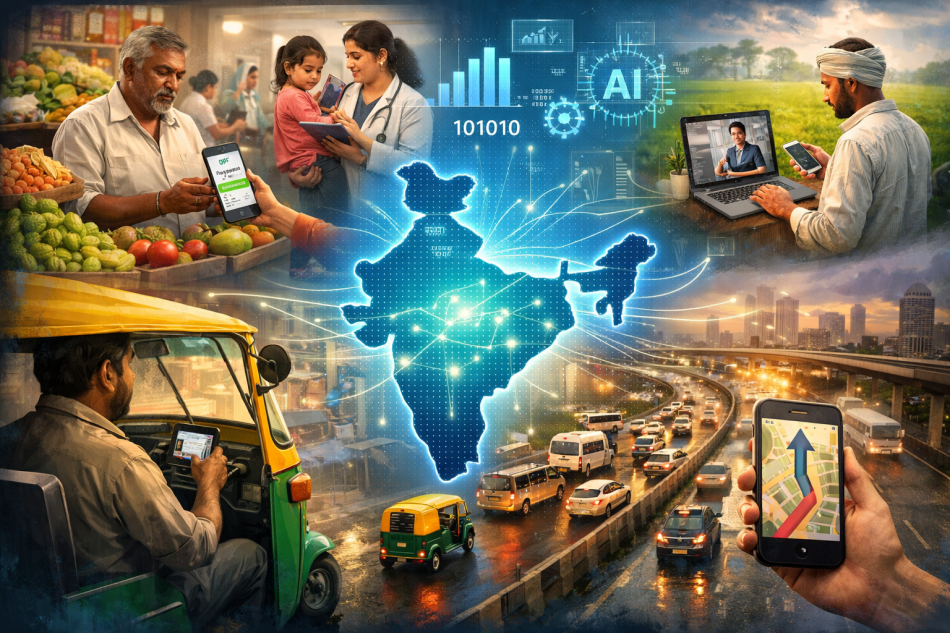
Every day, Indians generate data without intending to.
A vegetable seller accepting UPI.
A mother visiting a government hospital.
A student attending an online class.
A farmer checking rainfall updates.
A rickshaw driver using navigation to avoid traffic.
None of these actions feel political or powerful. Yet together, they create an enormous stream of information about how people live, move, fall sick, learn, earn, and survive.
For years, this data was treated as a side-effect of digital services — useful mainly to companies that collected it. Now, India is signalling a change. Data is increasingly being viewed as a national resource: something that carries collective value, not just private profit.
This shift is quiet, but it is significant. It influences how Artificial Intelligence (AI) is built, how public services are planned, and how decisions about citizens are made — often without direct consultation.
Understanding this change is not about understanding technology.
It is about understanding how power, care, and responsibility are evolving in a digital society.
What Exactly Is Changing?
At its heart, the shift is about how data is valued.
Earlier, data was seen as:
• a personal by-product of digital life, or
• a commercial asset owned by companies
Now, policymakers are increasingly treating certain forms of data as infrastructure — like roads or electricity. Invisible, but essential.
This does not mean personal data is being nationalised. It means that when data is:
• aggregated
• anonymised
• responsibly governed
it can be used to serve public goals such as health planning, disaster response, education reform, and traffic safety.
This thinking appears clearly in policy discussions, especially in the Economic Survey of India, which frames data as a driver of productivity, AI development, and governance quality.
The shift is subtle but important:
Data is no longer just something that records society.
It is something that increasingly shapes society.
Where Did This Thinking Come From?
This idea did not appear suddenly. It grew out of three parallel developments.
First, Artificial Intelligence changed the value of data. AI systems learn from large datasets. Countries that can responsibly manage diverse, high-quality data are better positioned to build AI suited to their own populations.
Second, India’s experience with large digital systems showed that data, when used well, can reduce friction and improve reach. Digital payments, service delivery platforms, and benefit transfers demonstrated that scale matters — but so does trust.
Third, global debates around data sovereignty raised alarms. Many countries realised that exporting raw data value while importing finished AI systems creates long-term dependence.
India’s policy thinking reflects this realisation:
If data fuels the future economy, leaving it unmanaged is not neutrality — it is vulnerability.
Whose Data Are We Talking About?
The simplest answer is also the most uncomfortable: everyone’s.
In today’s India, data is not created only by people using smartphones or social media. It is created whenever a person interacts with a system — often without realising it.
When a patient registers at a hospital, data is generated.
When a child’s attendance is marked in school, data is generated.
When a farmer’s land record is digitised, data is generated.
When a pension reaches a bank account, data is generated.
When a bus route is tracked or electricity usage is measured, data is generated.
Even people who do not own smartphones, do not use apps, or do not understand digital technology are part of these data systems. In the digital age, citizenship itself produces data.
This data reflects real lives — health, income, movement, education, vulnerability. Yet the people who create it rarely see it, control it, or benefit directly from it.
At present, much of this data is collected, stored, and processed by private platforms or fragmented government systems. Governments depend on it to plan services, but often lack full control over how it is analysed, combined, or reused. Citizens, meanwhile, remain largely invisible in these decisions.
Calling data a national resource is an attempt to change this imbalance.
It does not mean taking ownership away from individuals.
It means recognising that when millions of lives generate information, that information carries public responsibility.
The core question is not “Who owns the data?”
It is:
Who is accountable for how society’s data shapes decisions about society?
That is the heart of this shift.
Why Is This Happening Now?
Because data has crossed a threshold.
Earlier, data described the past.
Today, it predicts outcomes.
Algorithms now help decide:
• where hospitals are needed
• which students need support
• how cities respond to emergencies
• how risks are prioritised
At India’s scale, unmanaged data-driven decision-making can amplify inequality, bias, and exclusion.
The timing reflects recognition, not panic. Policymakers have realised that data governance delayed becomes data governance denied. The question is no longer whether data will be used. It is whether its use will be guided or accidental.
This shift is not driven by hostility toward technology or markets. It reflects a growing recognition that unmanaged data can quietly shape public life without accountability.
What This Means for Ordinary People
For most citizens, this shift will not arrive with an announcement or a rulebook. There will be no message saying, “Your data is now a national resource.”
Instead, the change will be felt indirectly, through systems that shape daily life.
Over time, decisions about hospitals, schools, traffic, welfare schemes, and public services will rely more heavily on data-driven assessments rather than local judgment or individual explanations. This can be helpful — but it can also feel distant.
For example, a hospital may prioritise resources based on patterns rather than individual stories. A welfare system may flag eligibility using digital records rather than face-to-face understanding. A city may redesign traffic or policing based on aggregated movement data, not lived inconvenience.
For many people, this will mean faster systems and fewer delays. For others, especially those who fall outside “average” patterns, it may feel like decisions are being made about them, without them.
This matters because data systems are not neutral. They reflect what is measured, what is ignored, and who is visible. If certain communities are underrepresented or misrepresented in data, the systems built on that data may unintentionally disadvantage them.
At the same time, responsible use of data can genuinely improve well-being — by identifying health risks early, targeting educational support, or improving access to services in underserved areas.
In simple terms:
Data can make systems smarter —
but only if they remain connected to human reality.
For ordinary people, the real impact of this shift will depend on whether data-driven governance remains responsive, fair, and open to correction, rather than rigid and unquestionable.
That is why this change deserves attention — not fear, but awareness.
Privacy, Consent, and Safeguards
Privacy concerns are not paranoia. They are practical.
Treating data as a national resource raises the standard for protection. Personal data must remain protected, consent-based, and purpose-limited.
The key distinction is crucial:
• personal data identifies individuals
• public-interest data studies trends
Safeguards are essential because systems tend to expand. Data collected for one purpose often attracts new uses — a process known as function creep.
Strong governance requires:
• clear legal limits
• independent oversight
• transparency
• grievance mechanisms
Trust is not built by intention.
It is built by restraint.
How Citizens Can Protect Themselves
- Protection begins with awareness, not expertise.
- Understand your data has value
- Pay attention to consent, especially for health and finance
- Question systems that affect you without explanation
- Support transparency over blind efficiency
- An informed public is the most effective safeguard.
Risks That Must Be Acknowledged
Treating data as a national resource carries promise, but it also introduces risks that cannot be brushed aside. These risks do not arise only from bad intentions. Very often, they emerge from systems that grow faster than the rules meant to guide them.
One major risk is the concentration of power. When large datasets are controlled by a small number of institutions — public or private — decisions can become opaque. Citizens may not know how conclusions are drawn, why certain areas receive attention while others do not, or how to challenge outcomes that affect their lives.
Another concern is the possibility of surveillance by design. This does not require deliberate monitoring of individuals. It can occur when different datasets — health, travel, welfare, identity — are gradually linked together. What begins as efficiency can slowly turn into constant observation, without clear public consent or debate.
There is also the risk of people being reduced to data profiles. Human lives are complex, but data systems depend on categories. When policies rely too heavily on numerical indicators, context is lost. Personal circumstances, temporary hardship, or social realities may be ignored because they do not fit neatly into datasets.
These risks are not distributed evenly. Vulnerable groups — those with limited digital access, language barriers, or weaker grievance mechanisms — are more likely to suffer from data errors, exclusions, or misclassification. For them, a wrong data point can mean denial of services or delayed help.
Finally, there is the danger of treating data-driven decisions as unquestionable. Numbers can appear objective, but they reflect human choices — what to collect, what to prioritise, and what to overlook.
Recognising these risks is not opposition to progress. It is the only way to ensure that data strengthens governance without weakening dignity, trust, or accountability.
Where This Could Take India ?
Treating data as a national resource does not lead to one fixed future. It opens multiple possible paths — and the direction India takes will depend less on technology and more on governance choices, public vigilance, and institutional culture.
In the best-case scenario, data strengthens public systems without eroding trust. Healthcare planning becomes proactive rather than reactive. Disease outbreaks are detected early. Learning gaps are identified before students drop out. Farmers receive advisories grounded in real field conditions, not averages. In this future, data acts quietly in the background, improving lives without demanding attention.
A middle path is more likely — where progress is uneven. Some sectors use data responsibly and transparently, while others struggle with outdated rules or weak oversight. Benefits exist, but they arrive slowly. Public debate continues, corrections are made, and trust is maintained, even if transformation is gradual. This path is not dramatic, but it is stable.
There is also a riskier path. If safeguards remain vague and accountability weak, data may drift from public service toward control. Decisions could become automated without adequate explanation. Appeals may become harder. People may feel managed rather than served. This shift would not happen overnight, but through quiet normalisation.
What determines the outcome is not data itself. It is:
• how clearly rules are defined
• how often systems are audited
• how easily citizens can question decisions
• how willing institutions are to admit mistakes
India stands at a quiet turning point. Data will shape the future regardless. The real choice is whether it does so with people at the centre, or merely about people.
Why This Debate Belongs to Everyone
It is easy to assume that discussions about data, AI, and national resources belong to experts, policymakers, or technology companies. That assumption is part of the problem.
This debate belongs to everyone because data is no longer separate from ordinary life. It is created quietly, continuously, and collectively — by people simply living their lives.
When a mother visits a clinic,
when a worker receives wages digitally,
when a child studies online,
when a farmer checks crop prices,
when a pension reaches a bank account —
data is generated.
These actions are not political acts. Yet the information they create increasingly shapes how policies are designed and how decisions are made.
In earlier times, citizenship was expressed through visible acts like voting, protesting, or paying taxes. Today, citizenship also has a digital footprint. People may not choose to create data, but they live inside systems that depend on it.
That makes awareness essential.
Silence or lack of understanding can slowly turn into passive consent. When decisions become technical and invisible, they move forward without public questioning. This is not because people agree, but because they feel excluded from the conversation.
Public debate does not require technical expertise. It requires asking simple, human questions:
• Who benefits from this system?
• Who is protected if something goes wrong?
• Who can be held accountable?
If data is treated as a national resource, then responsibility must also be shared, not concentrated.
The future of data governance will not be decided only in policy rooms or court judgments. It will be shaped by how alert, informed, and engaged citizens remain.
Calling data a national resource does not automatically lead to control. It can also create the conditions for better care – but only if governance keeps people visible.
The real question is not whether data will be used. That is already settled.
The real question is: Will data strengthen people’s lives or will people slowly be reduced to data?
That answer depends on public attention, democratic values, and the willingness to keep this conversation alive.
This shift is quiet, but lasting. Understanding it is not about learning technology. It is about understanding how care, power, and accountability work in a digital society.

 NehaScope
Every day, Indians generate data without intending to.
A vegetable seller accepting UPI.
A mother visiting a government hospital.
A student attending an online class.
A farmer checking rainfall updates.
A rickshaw driver using navigation to avoid traffic.
None of these actions feel political or powerful. Yet together, they create an enormous stream of information about how people live, move, fall sick, learn, earn, and survive.
For years, this data was treated as a side-effect of digital services — useful mainly to companies that collected it. Now, India is signalling a change. Data is increasingly being viewed as a national resource: something that carries collective value, not just private profit.
This shift is quiet, but it is significant. It influences how Artificial Intelligence (AI) is built, how public services are planned, and how decisions about citizens are made — often without direct consultation.
Understanding this change is not about understanding technology.
It is about understanding how power, care, and responsibility are evolving in a digital society.
What Exactly Is Changing?
At its heart, the shift is about how data is valued.
Earlier, data was seen as:
• a personal by-product of digital life, or
• a commercial asset owned by companies
Now, policymakers are increasingly treating certain forms of data as infrastructure — like roads or electricity. Invisible, but essential.
This does not mean personal data is being nationalised. It means that when data is:
• aggregated
• anonymised
• responsibly governed
it can be used to serve public goals such as health planning, disaster response, education reform, and traffic safety.
This thinking appears clearly in policy discussions, especially in the Economic Survey of India, which frames data as a driver of productivity, AI development, and governance quality.
The shift is subtle but important:
Data is no longer just something that records society.
It is something that increasingly shapes society.
Where Did This Thinking Come From?
This idea did not appear suddenly. It grew out of three parallel developments.
First, Artificial Intelligence changed the value of data. AI systems learn from large datasets. Countries that can responsibly manage diverse, high-quality data are better positioned to build AI suited to their own populations.
Second, India’s experience with large digital systems showed that data, when used well, can reduce friction and improve reach. Digital payments, service delivery platforms, and benefit transfers demonstrated that scale matters — but so does trust.
Third, global debates around data sovereignty raised alarms. Many countries realised that exporting raw data value while importing finished AI systems creates long-term dependence.
India’s policy thinking reflects this realisation:
If data fuels the future economy, leaving it unmanaged is not neutrality — it is vulnerability.
Whose Data Are We Talking About?
The simplest answer is also the most uncomfortable: everyone’s.
In today’s India, data is not created only by people using smartphones or social media. It is created whenever a person interacts with a system — often without realising it.
When a patient registers at a hospital, data is generated.
When a child’s attendance is marked in school, data is generated.
When a farmer’s land record is digitised, data is generated.
When a pension reaches a bank account, data is generated.
When a bus route is tracked or electricity usage is measured, data is generated.
Even people who do not own smartphones, do not use apps, or do not understand digital technology are part of these data systems. In the digital age, citizenship itself produces data.
This data reflects real lives — health, income, movement, education, vulnerability. Yet the people who create it rarely see it, control it, or benefit directly from it.
At present, much of this data is collected, stored, and processed by private platforms or fragmented government systems. Governments depend on it to plan services, but often lack full control over how it is analysed, combined, or reused. Citizens, meanwhile, remain largely invisible in these decisions.
Calling data a national resource is an attempt to change this imbalance.
It does not mean taking ownership away from individuals.
It means recognising that when millions of lives generate information, that information carries public responsibility.
The core question is not “Who owns the data?”
It is:
Who is accountable for how society’s data shapes decisions about society?
That is the heart of this shift.
Why Is This Happening Now?
Because data has crossed a threshold.
Earlier, data described the past.
Today, it predicts outcomes.
Algorithms now help decide:
• where hospitals are needed
• which students need support
• how cities respond to emergencies
• how risks are prioritised
At India’s scale, unmanaged data-driven decision-making can amplify inequality, bias, and exclusion.
The timing reflects recognition, not panic. Policymakers have realised that data governance delayed becomes data governance denied. The question is no longer whether data will be used. It is whether its use will be guided or accidental.
What This Means for Ordinary People
For most citizens, this shift will not arrive with an announcement or a rulebook. There will be no message saying, “Your data is now a national resource.”
Instead, the change will be felt indirectly, through systems that shape daily life.
Over time, decisions about hospitals, schools, traffic, welfare schemes, and public services will rely more heavily on data-driven assessments rather than local judgment or individual explanations. This can be helpful — but it can also feel distant.
For example, a hospital may prioritise resources based on patterns rather than individual stories. A welfare system may flag eligibility using digital records rather than face-to-face understanding. A city may redesign traffic or policing based on aggregated movement data, not lived inconvenience.
For many people, this will mean faster systems and fewer delays. For others, especially those who fall outside “average” patterns, it may feel like decisions are being made about them, without them.
This matters because data systems are not neutral. They reflect what is measured, what is ignored, and who is visible. If certain communities are underrepresented or misrepresented in data, the systems built on that data may unintentionally disadvantage them.
At the same time, responsible use of data can genuinely improve well-being — by identifying health risks early, targeting educational support, or improving access to services in underserved areas.
In simple terms:
Data can make systems smarter —
but only if they remain connected to human reality.
For ordinary people, the real impact of this shift will depend on whether data-driven governance remains responsive, fair, and open to correction, rather than rigid and unquestionable.
That is why this change deserves attention — not fear, but awareness.
Privacy, Consent, and Safeguards
Privacy concerns are not paranoia. They are practical.
Treating data as a national resource raises the standard for protection. Personal data must remain protected, consent-based, and purpose-limited.
The key distinction is crucial:
• personal data identifies individuals
• public-interest data studies trends
Safeguards are essential because systems tend to expand. Data collected for one purpose often attracts new uses — a process known as function creep.
Strong governance requires:
• clear legal limits
• independent oversight
• transparency
• grievance mechanisms
Trust is not built by intention.
It is built by restraint.
Risks That Must Be Acknowledged
Treating data as a national resource carries promise, but it also introduces risks that cannot be brushed aside. These risks do not arise only from bad intentions. Very often, they emerge from systems that grow faster than the rules meant to guide them.
One major risk is the concentration of power. When large datasets are controlled by a small number of institutions — public or private — decisions can become opaque. Citizens may not know how conclusions are drawn, why certain areas receive attention while others do not, or how to challenge outcomes that affect their lives.
Another concern is the possibility of surveillance by design. This does not require deliberate monitoring of individuals. It can occur when different datasets — health, travel, welfare, identity — are gradually linked together. What begins as efficiency can slowly turn into constant observation, without clear public consent or debate.
There is also the risk of people being reduced to data profiles. Human lives are complex, but data systems depend on categories. When policies rely too heavily on numerical indicators, context is lost. Personal circumstances, temporary hardship, or social realities may be ignored because they do not fit neatly into datasets.
These risks are not distributed evenly. Vulnerable groups — those with limited digital access, language barriers, or weaker grievance mechanisms — are more likely to suffer from data errors, exclusions, or misclassification. For them, a wrong data point can mean denial of services or delayed help.
Finally, there is the danger of treating data-driven decisions as unquestionable. Numbers can appear objective, but they reflect human choices — what to collect, what to prioritise, and what to overlook.
Recognising these risks is not opposition to progress. It is the only way to ensure that data strengthens governance without weakening dignity, trust, or accountability.
Where This Could Take India ?
Treating data as a national resource does not lead to one fixed future. It opens multiple possible paths — and the direction India takes will depend less on technology and more on governance choices, public vigilance, and institutional culture.
In the best-case scenario, data strengthens public systems without eroding trust. Healthcare planning becomes proactive rather than reactive. Disease outbreaks are detected early. Learning gaps are identified before students drop out. Farmers receive advisories grounded in real field conditions, not averages. In this future, data acts quietly in the background, improving lives without demanding attention.
A middle path is more likely — where progress is uneven. Some sectors use data responsibly and transparently, while others struggle with outdated rules or weak oversight. Benefits exist, but they arrive slowly. Public debate continues, corrections are made, and trust is maintained, even if transformation is gradual. This path is not dramatic, but it is stable.
There is also a riskier path. If safeguards remain vague and accountability weak, data may drift from public service toward control. Decisions could become automated without adequate explanation. Appeals may become harder. People may feel managed rather than served. This shift would not happen overnight, but through quiet normalisation.
What determines the outcome is not data itself. It is:
• how clearly rules are defined
• how often systems are audited
• how easily citizens can question decisions
• how willing institutions are to admit mistakes
India stands at a quiet turning point. Data will shape the future regardless. The real choice is whether it does so with people at the centre, or merely about people.
Why This Debate Belongs to Everyone
It is easy to assume that discussions about data, AI, and national resources belong to experts, policymakers, or technology companies. That assumption is part of the problem.
This debate belongs to everyone because data is no longer separate from ordinary life. It is created quietly, continuously, and collectively — by people simply living their lives.
When a mother visits a clinic,
when a worker receives wages digitally,
when a child studies online,
when a farmer checks crop prices,
when a pension reaches a bank account —
data is generated.
These actions are not political acts. Yet the information they create increasingly shapes how policies are designed and how decisions are made.
In earlier times, citizenship was expressed through visible acts like voting, protesting, or paying taxes. Today, citizenship also has a digital footprint. People may not choose to create data, but they live inside systems that depend on it.
That makes awareness essential.
Silence or lack of understanding can slowly turn into passive consent. When decisions become technical and invisible, they move forward without public questioning. This is not because people agree, but because they feel excluded from the conversation.
Public debate does not require technical expertise. It requires asking simple, human questions:
• Who benefits from this system?
• Who is protected if something goes wrong?
• Who can be held accountable?
If data is treated as a national resource, then responsibility must also be shared, not concentrated.
The future of data governance will not be decided only in policy rooms or court judgments. It will be shaped by how alert, informed, and engaged citizens remain.
The real question is not whether data will be used. That is already settled.
The real question is: Will data strengthen people’s lives or will people slowly be reduced to data?
That answer depends on public attention, democratic values, and the willingness to keep this conversation alive.
This shift is quiet, but lasting. Understanding it is not about learning technology. It is about understanding how care, power, and accountability work in a digital society.
Share this: