When an astronaut retires, the word retirement feels inadequate. It suggests rest, closure, a slowing down. Spaceflight has a different vocabulary. Journeys end not with full stops, but with re-entry careful, calculated, and precise.
Sunita Williams’s career belongs to that language.
She did not simply “go to space.” She lived there. She worked there. She led from there. For months at a time, Earth was not beneath her feet but framed in a window rotating silently, without borders, without noise. In that environment, nothing is symbolic. Every action has consequence. Every decision carries weight, even when gravity does not.
This is why her retirement matters.
Not because a famous astronaut is stepping back, but because one of the most experienced human beings in sustained space habitation is completing an operational orbit handing over knowledge that cannot be learned from simulations alone. Her career represents an era where spaceflight stopped being short visits and became long-term living, problem-solving, and leadership in isolation.
For science, this moment is about continuity.
For society, it is about perspective.
And for anyone watching from Earth, it is a reminder that exploration is not spectacle it is discipline practiced far away from applause.
Before NASA: Training the Mind That Would Leave Earth
Long before space, there was structure.
Sunita Williams’ professional foundation was not built on dreams of orbit, but on procedures, checklists, and accountability. A graduate of the United States Naval Academy, she trained as a Naval Aviator and later as a test pilot a role defined by controlled risk and analytical thinking.
Test pilots are not selected for bravery alone. They are selected for their ability to detect anomalies early, communicate clearly under pressure, and fly aircraft that may not behave as expected. These skills translate directly to spaceflight, where improvisation is limited and judgment must remain steady even when systems fail quietly.
This phase of her life matters because astronauts are not chosen for heroism. They are chosen for reliability.
How Astronauts Are Filtered, Not Found
Becoming an astronaut is not about excellence in one domain. It is about acceptable competence across many.
NASA’s astronaut selection process evaluates:
• Physical endurance and long-term health risk
• Technical mastery across multiple systems
• Psychological stability in isolation
• Ability to function within tightly coupled teams
Most candidates are eliminated not for lack of intelligence, but for lack of operational compatibility. Spaceflight compresses human error margins. People who require constant validation or hierarchy struggle in orbit.
Williams’ selection placed her among individuals trusted to operate complex systems where help is delayed and mistakes are expensive. That trust is the real credential.
Life Aboard the ISS: Sunita Williams and the Discipline of Weightlessness
For months at a time, Sunita Williams lived at a distance where ordinary reassurances did not exist. Family, hospitals, and immediate help were not nearby they were moving beneath her, locked to a planet she could see but not reach. Earth was present, always visible, yet inaccessible. That distance did not interrupt the work, but it quietly reframed it.
For Sunita Williams, life aboard the International Space Station was not an abstract experiment in microgravity. It was a daily operational routine, repeated over months, where discipline mattered more than novelty.
Her days in orbit were structured around responsibility. She was not only conducting experiments; she was also maintaining the station itself. That meant monitoring life-support systems, checking power and thermal controls, managing onboard equipment, and responding to routine alerts that cannot be postponed simply because help is far away.
Like all long-duration astronauts, Williams followed a strict physical conditioning schedule, often spending around two hours a day exercising. This was not for fitness in the usual sense. It was medical necessity. Without gravity, the body begins to lose bone density and muscle strength rapidly. Running on a treadmill required a harness to keep her body anchored. Strength training relied on resistance devices designed to mimic weight where none exists.
Over time, the effects of microgravity were unavoidable and measurable. Fluids in the body shifted upward, often causing facial puffiness and pressure changes that affected vision. Sleep was fragmented not by noise, but by the station’s rapid orbit, which brings multiple sunrises and sunsets within a single Earth day. Fatigue had to be managed carefully, because decision-making in space does not allow for error.
Williams’ long stays aboard the ISS placed her among astronauts whose bodies became part of the data. Her missions contributed to understanding which physiological changes reverse after return to Earth and which require long rehabilitation. This knowledge is not academic. It directly informs how space agencies plan future long-duration missions, including those that aim far beyond low Earth orbit.
In space, nothing about the body can be taken for granted. Sunita Williams’ experience made that reality visible not through explanation, but through endurance.
Held the record for most cumulative EVA time by a woman (at the time of completion)
Why These Numbers Matter
• 322 days in space places her among astronauts whose bodies and minds contributed critical data for long-duration human spaceflight
• 7 spacewalks reflect operational trust, not symbolism
• 50+ hours outside the ISS means sustained work in vacuum, not brief exposure
Commanding the ISS signals institutional confidence in judgment under isolation
Figures based on publicly available NASA mission records and ISS expedition data. The fact box reflects completed missions and verified EVA totals.
Outside the Station: Sunita Williams and the Work Done in Vacuum
For Sunita Williams, a spacewalk was never an act of spectacle. It was external maintenance, carried out in conditions where the environment offers no forgiveness.
When she stepped outside the International Space Station, she entered a space that cannot support life, sound, or error. The suit she wore was not protective clothing; it was a personal spacecraft, responsible for oxygen supply, temperature control, communication, and pressure regulation. Every movement inside it required effort. Even simple tasks demanded planning, strength, and restraint.
Williams’ spacewalks involved practical objectives installing equipment, repositioning hardware, supporting repairs, and assisting in upgrades to the station’s systems. Tools had to be secured at all times. A dropped object does not fall; it drifts, potentially becoming a hazard. Handholds and tethers were lifelines, not conveniences.
Outside the station, time behaves differently. Tasks take longer than planned. Fatigue accumulates quickly. Hands swell inside pressurised gloves, reducing dexterity. Every action is governed by checklists rehearsed repeatedly on Earth, because improvisation in vacuum is not a strength it is a risk.
Her repeated spacewalks added to operational knowledge about human performance in extravehicular activity: how long fine motor skills can be maintained, how the body tolerates prolonged exposure in a pressurised suit, and how focus degrades under physical strain. These are not dramatic insights, but they are essential ones.
For Williams, working outside the station was not about pushing limits. It was about keeping a complex system alive, one deliberate movement at a time.
Commanding the ISS: Authority Without Distance
When Sunita Williams commanded the International Space Station, the title did not change her environment. It clarified her responsibility.
Command of the ISS is not ceremonial leadership. It is functional authority exercised inside a system that cannot be paused, evacuated easily, or corrected quickly from Earth. Every day, the station must remain powered, pressurised, thermally balanced, and operational. As commander, Williams was responsible for ensuring that this system and the people living inside it continued to function safely.
Her role involved coordinating a multinational crew operating under different training cultures, languages, and institutional habits. In orbit, hierarchy flattens quickly. What remains is competence. Decisions are discussed, but they must be taken. Problems are reported to ground control, but the first response often happens on board, with limited time and incomplete information.
Communication delays, though brief in low Earth orbit, still matter. Procedures are followed rigorously, but real situations rarely align perfectly with manuals. Command meant knowing when to adhere strictly to protocol and when to pause, reassess, and seek clarification before acting. Calm was not a personality trait; it was a requirement.
Williams’ experience as a test pilot shaped this style of leadership. Risk was not confronted emotionally, but analytically. Crew well-being, workload balance, and fatigue management were as important as technical outcomes, because human error in space propagates faster than mechanical failure.
From inside the station, command did not look heroic. It looked methodical. It was the steady management of people and systems, day after day, in an environment where small oversights can escalate and where responsibility cannot be delegated away.
In orbit, leadership is measured not by visibility, but by stability. Under Sunita Williams’ command, the station continued to do what it is designed to do: remain inhabited, functional, and safe quietly, continuously, and without drama.
India, Visibility, and What She Carried Into Orbit
Sunita Williams never flew to space as a representative of a nation. She flew as an astronaut trained to operate complex systems under risk. And yet, her Indian heritage travelled with her not as identity politics, but as recognition that followed performance.
Her connection to India was not manufactured after fame. It was acknowledged repeatedly because it was real and visible spoken about openly by her, reflected in how Indian audiences responded to her work, and reinforced by the consistency of her missions. For many in India, she became the first concrete proof that space science was not distant or abstract, not limited by geography or accent.
What mattered was not symbolism, but repetition. She did not appear once and disappear. She returned to orbit again and again. She stayed longer. She took on responsibility. She commanded. That continuity did more for representation than any speech could.
In Indian classrooms, her story did not inspire because it was emotional. It inspired because it was verifiable. There was a record. There were missions. There was time logged in orbit. Visibility, in her case, emerged from credibility sustained over years not from momentary celebration.
Sunita Williams — Missions That Defined Long-Duration Spaceflight
Time Period
Mission / Phase
Key Details
Why It Mattered
1998
Selected as NASA Astronaut
Selected in NASA Astronaut Group 17, a cohort prepared for long-duration ISS missions rather than short shuttle flights
Marked entry into a generation trained for sustained human presence in space
Dec 2006 – Jun 2007
STS-116 → Expedition 14 / Expedition 15 (ISS)
• Launched aboard Space Shuttle Discovery • Lived aboard the ISS for ~195 days • Conducted multiple spacewalks for station construction and maintenance • Set a then-record for cumulative spacewalk time by a female astronaut
Reflected NASA’s shift from visit-based missions to continuous habitation of space
• Launched aboard a Russian Soyuz spacecraft • Served as Commander of the ISS during Expedition 33 • Responsible for crew safety, mission coordination, and station operations
Command role demonstrated institutional trust in her leadership during long-duration missions
Career Totals (by 2012)
Long-Duration Flight Record
• Total time in space: ~322 days • Spacewalks: 7 • Total EVA time: ~50 hours
Became benchmark data for studying human endurance and performance in microgravity
2024 – 2025
Boeing Starliner Crew Flight Test (CFT)
• Flew as pilot on Starliner’s first crewed test mission • Mission duration extended due to spacecraft evaluation and safety reviews • Returned to Earth under a NASA-approved alternate crew return plan
Demonstrated operational handling of uncertainty and extended timelines late in an astronaut’s career
2025 – 2026
Transition from Active Flight Status
• Shift from active flight duties to advisory, mentoring, and program-support roles
Marked completion of a career defined by endurance, responsibility, and institutional contribution
Extended Missions and Uncertainty: Time as a Variable, Not a Promise
Sunita Williams’ career unfolded during a phase when spaceflight timelines stopped behaving neatly.
Extended missions were not presented to her as crises. They were framed as outcomes products of safety assessments, hardware performance, mission priorities, and operational caution that routinely override personal schedules. Launch dates were fixed. Return dates existed, but they were never absolute.
Living with that uncertainty was part of her professional reality. When plans shifted, the work did not. Systems still required monitoring. Experiments had to be completed. Physical conditioning remained mandatory, not optional. The discipline of orbit does not adjust for disappointment or delay.
What prolonged missions test most severely is not courage, but psychological elasticity the ability to absorb change without allowing it to degrade focus. Confinement becomes ordinary. Privacy remains limited. Routines repeat without variation. Mental fatigue accumulates quietly, not from fear, but from constancy. The station never sleeps, and neither does the responsibility to remain attentive.
Williams’ repeated long-duration stays contributed to understanding how astronauts function when uncertainty becomes routine rather than exceptional: how performance is maintained when timelines become provisional, how morale is sustained without novelty, and how attention is preserved when days blur into one another.
This experience matters because future missions will demand even greater tolerance for indeterminate time journeys longer, farther, and more isolated than those in low Earth orbit. Sunita Williams’ career sits directly inside that transition, showing that preparation can reduce panic, but cannot eliminate unpredictability.
In space, uncertainty is rarely dramatic. It unfolds quietly, day after day. The challenge is not surviving the unknown, but continuing to function calmly when the unknown becomes normal.
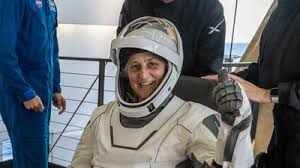
SpaceX Dragon spacecraft in the water off the coast of Tallahassee, Fla., March 18, 2025.
What Sunita Williams Leaves Behind
Astronauts do not leave space when they stop flying. They leave it when their judgment has been fully absorbed by the system.
Sunita Williams’ value to spaceflight now lies in experience that cannot be simulated: how bodies behave after months in orbit, how fatigue accumulates quietly, how teams function when confined for long periods, and how decision-making changes when Earth is distant but consequences are immediate.
Her post-flight role like that of all senior astronauts extends into training, safety evaluation, mission planning, and institutional memory. These are not visible contributions, but they are decisive ones. Space agencies rely on people who have seen systems fail gently before they fail loudly.
Exploration does not move forward by replacing individuals. It moves forward by retaining what they learned. Williams’ career adds weight to that accumulation not through headlines, but through endurance.
The View That Never Leaves
Astronauts return to Earth, but they do not return unchanged.
Those who have seen the planet from orbit describe a shift that science can measure but language struggles to hold. Earth appears complete, finite, and extraordinarily vulnerable. Storms have no flags. Borders vanish. Fragility becomes visible.
This is not philosophy. It is observation.
Sunita Williams carries that observation back not as a story to impress, but as a quiet calibration of how small actions matter when systems are delicate. Space teaches this relentlessly. Life-support systems do not tolerate waste. Teamwork is not motivational language; it is survival. Preparation is not optional. And errors, however small, compound quickly.
Her retirement does not mark an exit from relevance. It marks a transition from execution to inheritance. The value now lies in what she leaves behind: training methods refined by reality, judgment shaped under pressure, and an understanding of human limits tested far beyond laboratories.
Some journeys are measured in distance.
Others are measured in how permanently they alter the way a person sees home.
Sunita Williams’ journey belongs to the second kind. The orbit is complete. The view remains.

 NehaScope
When an astronaut retires, the word retirement feels inadequate. It suggests rest, closure, a slowing down. Spaceflight has a different vocabulary. Journeys end not with full stops, but with re-entry careful, calculated, and precise.
Sunita Williams’s career belongs to that language.
She did not simply “go to space.” She lived there. She worked there. She led from there. For months at a time, Earth was not beneath her feet but framed in a window rotating silently, without borders, without noise. In that environment, nothing is symbolic. Every action has consequence. Every decision carries weight, even when gravity does not.
This is why her retirement matters.
Not because a famous astronaut is stepping back, but because one of the most experienced human beings in sustained space habitation is completing an operational orbit handing over knowledge that cannot be learned from simulations alone. Her career represents an era where spaceflight stopped being short visits and became long-term living, problem-solving, and leadership in isolation.
For science, this moment is about continuity.
For society, it is about perspective.
And for anyone watching from Earth, it is a reminder that exploration is not spectacle it is discipline practiced far away from applause.
Before NASA: Training the Mind That Would Leave Earth
Long before space, there was structure.
Sunita Williams’ professional foundation was not built on dreams of orbit, but on procedures, checklists, and accountability. A graduate of the United States Naval Academy, she trained as a Naval Aviator and later as a test pilot a role defined by controlled risk and analytical thinking.
Test pilots are not selected for bravery alone. They are selected for their ability to detect anomalies early, communicate clearly under pressure, and fly aircraft that may not behave as expected. These skills translate directly to spaceflight, where improvisation is limited and judgment must remain steady even when systems fail quietly.
This phase of her life matters because astronauts are not chosen for heroism. They are chosen for reliability.
How Astronauts Are Filtered, Not Found
Becoming an astronaut is not about excellence in one domain. It is about acceptable competence across many.
NASA’s astronaut selection process evaluates:
• Physical endurance and long-term health risk
• Technical mastery across multiple systems
• Psychological stability in isolation
• Ability to function within tightly coupled teams
Most candidates are eliminated not for lack of intelligence, but for lack of operational compatibility. Spaceflight compresses human error margins. People who require constant validation or hierarchy struggle in orbit.
Williams’ selection placed her among individuals trusted to operate complex systems where help is delayed and mistakes are expensive. That trust is the real credential.
Life Aboard the ISS: Sunita Williams and the Discipline of Weightlessness
For months at a time, Sunita Williams lived at a distance where ordinary reassurances did not exist. Family, hospitals, and immediate help were not nearby they were moving beneath her, locked to a planet she could see but not reach. Earth was present, always visible, yet inaccessible. That distance did not interrupt the work, but it quietly reframed it.
For Sunita Williams, life aboard the International Space Station was not an abstract experiment in microgravity. It was a daily operational routine, repeated over months, where discipline mattered more than novelty.
Her days in orbit were structured around responsibility. She was not only conducting experiments; she was also maintaining the station itself. That meant monitoring life-support systems, checking power and thermal controls, managing onboard equipment, and responding to routine alerts that cannot be postponed simply because help is far away.
Like all long-duration astronauts, Williams followed a strict physical conditioning schedule, often spending around two hours a day exercising. This was not for fitness in the usual sense. It was medical necessity. Without gravity, the body begins to lose bone density and muscle strength rapidly. Running on a treadmill required a harness to keep her body anchored. Strength training relied on resistance devices designed to mimic weight where none exists.
Over time, the effects of microgravity were unavoidable and measurable. Fluids in the body shifted upward, often causing facial puffiness and pressure changes that affected vision. Sleep was fragmented not by noise, but by the station’s rapid orbit, which brings multiple sunrises and sunsets within a single Earth day. Fatigue had to be managed carefully, because decision-making in space does not allow for error.
Williams’ long stays aboard the ISS placed her among astronauts whose bodies became part of the data. Her missions contributed to understanding which physiological changes reverse after return to Earth and which require long rehabilitation. This knowledge is not academic. It directly informs how space agencies plan future long-duration missions, including those that aim far beyond low Earth orbit.
In space, nothing about the body can be taken for granted. Sunita Williams’ experience made that reality visible not through explanation, but through endurance.
Outside the Station: Sunita Williams and the Work Done in Vacuum
For Sunita Williams, a spacewalk was never an act of spectacle. It was external maintenance, carried out in conditions where the environment offers no forgiveness.
When she stepped outside the International Space Station, she entered a space that cannot support life, sound, or error. The suit she wore was not protective clothing; it was a personal spacecraft, responsible for oxygen supply, temperature control, communication, and pressure regulation. Every movement inside it required effort. Even simple tasks demanded planning, strength, and restraint.
Williams’ spacewalks involved practical objectives installing equipment, repositioning hardware, supporting repairs, and assisting in upgrades to the station’s systems. Tools had to be secured at all times. A dropped object does not fall; it drifts, potentially becoming a hazard. Handholds and tethers were lifelines, not conveniences.
Outside the station, time behaves differently. Tasks take longer than planned. Fatigue accumulates quickly. Hands swell inside pressurised gloves, reducing dexterity. Every action is governed by checklists rehearsed repeatedly on Earth, because improvisation in vacuum is not a strength it is a risk.
Her repeated spacewalks added to operational knowledge about human performance in extravehicular activity: how long fine motor skills can be maintained, how the body tolerates prolonged exposure in a pressurised suit, and how focus degrades under physical strain. These are not dramatic insights, but they are essential ones.
For Williams, working outside the station was not about pushing limits. It was about keeping a complex system alive, one deliberate movement at a time.
Commanding the ISS: Authority Without Distance
When Sunita Williams commanded the International Space Station, the title did not change her environment. It clarified her responsibility.
Command of the ISS is not ceremonial leadership. It is functional authority exercised inside a system that cannot be paused, evacuated easily, or corrected quickly from Earth. Every day, the station must remain powered, pressurised, thermally balanced, and operational. As commander, Williams was responsible for ensuring that this system and the people living inside it continued to function safely.
Her role involved coordinating a multinational crew operating under different training cultures, languages, and institutional habits. In orbit, hierarchy flattens quickly. What remains is competence. Decisions are discussed, but they must be taken. Problems are reported to ground control, but the first response often happens on board, with limited time and incomplete information.
Communication delays, though brief in low Earth orbit, still matter. Procedures are followed rigorously, but real situations rarely align perfectly with manuals. Command meant knowing when to adhere strictly to protocol and when to pause, reassess, and seek clarification before acting. Calm was not a personality trait; it was a requirement.
Williams’ experience as a test pilot shaped this style of leadership. Risk was not confronted emotionally, but analytically. Crew well-being, workload balance, and fatigue management were as important as technical outcomes, because human error in space propagates faster than mechanical failure.
From inside the station, command did not look heroic. It looked methodical. It was the steady management of people and systems, day after day, in an environment where small oversights can escalate and where responsibility cannot be delegated away.
In orbit, leadership is measured not by visibility, but by stability. Under Sunita Williams’ command, the station continued to do what it is designed to do: remain inhabited, functional, and safe quietly, continuously, and without drama.
India, Visibility, and What She Carried Into Orbit
Sunita Williams never flew to space as a representative of a nation. She flew as an astronaut trained to operate complex systems under risk. And yet, her Indian heritage travelled with her not as identity politics, but as recognition that followed performance.
Her connection to India was not manufactured after fame. It was acknowledged repeatedly because it was real and visible spoken about openly by her, reflected in how Indian audiences responded to her work, and reinforced by the consistency of her missions. For many in India, she became the first concrete proof that space science was not distant or abstract, not limited by geography or accent.
What mattered was not symbolism, but repetition. She did not appear once and disappear. She returned to orbit again and again. She stayed longer. She took on responsibility. She commanded. That continuity did more for representation than any speech could.
In Indian classrooms, her story did not inspire because it was emotional. It inspired because it was verifiable. There was a record. There were missions. There was time logged in orbit. Visibility, in her case, emerged from credibility sustained over years not from momentary celebration.
Sunita Williams — Missions That Defined Long-Duration Spaceflight
Extended Missions and Uncertainty: Time as a Variable, Not a Promise
Sunita Williams’ career unfolded during a phase when spaceflight timelines stopped behaving neatly.
Extended missions were not presented to her as crises. They were framed as outcomes products of safety assessments, hardware performance, mission priorities, and operational caution that routinely override personal schedules. Launch dates were fixed. Return dates existed, but they were never absolute.
Living with that uncertainty was part of her professional reality. When plans shifted, the work did not. Systems still required monitoring. Experiments had to be completed. Physical conditioning remained mandatory, not optional. The discipline of orbit does not adjust for disappointment or delay.
What prolonged missions test most severely is not courage, but psychological elasticity the ability to absorb change without allowing it to degrade focus. Confinement becomes ordinary. Privacy remains limited. Routines repeat without variation. Mental fatigue accumulates quietly, not from fear, but from constancy. The station never sleeps, and neither does the responsibility to remain attentive.
Williams’ repeated long-duration stays contributed to understanding how astronauts function when uncertainty becomes routine rather than exceptional: how performance is maintained when timelines become provisional, how morale is sustained without novelty, and how attention is preserved when days blur into one another.
This experience matters because future missions will demand even greater tolerance for indeterminate time journeys longer, farther, and more isolated than those in low Earth orbit. Sunita Williams’ career sits directly inside that transition, showing that preparation can reduce panic, but cannot eliminate unpredictability.
In space, uncertainty is rarely dramatic. It unfolds quietly, day after day. The challenge is not surviving the unknown, but continuing to function calmly when the unknown becomes normal.
in the water off the coast of Tallahassee, Fla., March 18, 2025.
What Sunita Williams Leaves Behind
Astronauts do not leave space when they stop flying. They leave it when their judgment has been fully absorbed by the system.
Sunita Williams’ value to spaceflight now lies in experience that cannot be simulated: how bodies behave after months in orbit, how fatigue accumulates quietly, how teams function when confined for long periods, and how decision-making changes when Earth is distant but consequences are immediate.
Her post-flight role like that of all senior astronauts extends into training, safety evaluation, mission planning, and institutional memory. These are not visible contributions, but they are decisive ones. Space agencies rely on people who have seen systems fail gently before they fail loudly.
Exploration does not move forward by replacing individuals. It moves forward by retaining what they learned. Williams’ career adds weight to that accumulation not through headlines, but through endurance.
The View That Never Leaves
Astronauts return to Earth, but they do not return unchanged.
Those who have seen the planet from orbit describe a shift that science can measure but language struggles to hold. Earth appears complete, finite, and extraordinarily vulnerable. Storms have no flags. Borders vanish. Fragility becomes visible.
This is not philosophy. It is observation.
Sunita Williams carries that observation back not as a story to impress, but as a quiet calibration of how small actions matter when systems are delicate. Space teaches this relentlessly. Life-support systems do not tolerate waste. Teamwork is not motivational language; it is survival. Preparation is not optional. And errors, however small, compound quickly.
Her retirement does not mark an exit from relevance. It marks a transition from execution to inheritance. The value now lies in what she leaves behind: training methods refined by reality, judgment shaped under pressure, and an understanding of human limits tested far beyond laboratories.
Some journeys are measured in distance.
Others are measured in how permanently they alter the way a person sees home.
Sunita Williams’ journey belongs to the second kind. The orbit is complete. The view remains.
Share this: