Prologue: a terrace, a telescope, a trillion dreams
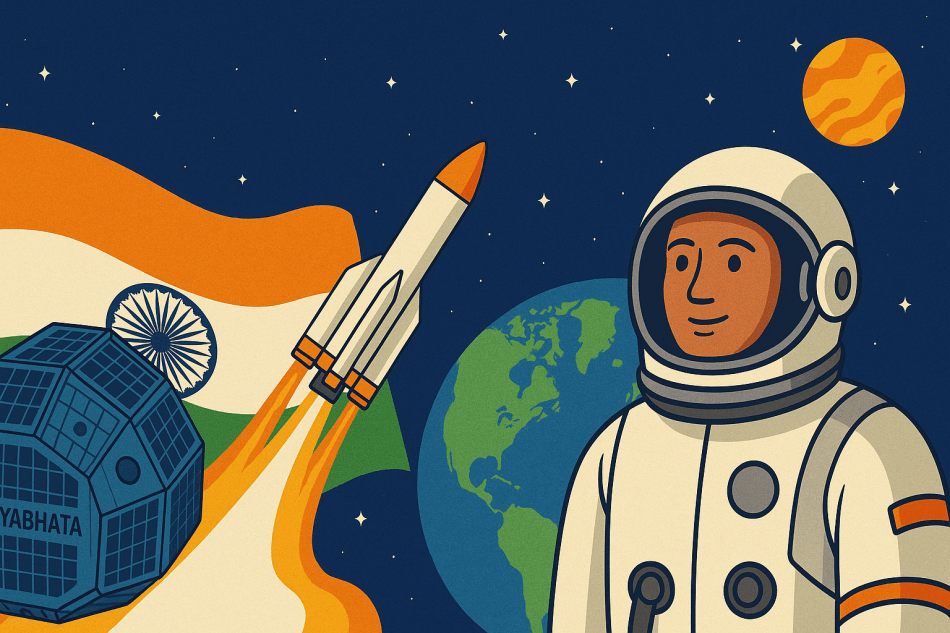
In 2025, a 12‑year‑old in Lucknow points a tiny telescope at the Moon while her grandmother recalls a different India—the one that launched Aryabhata in 1975 and rolled rocket parts on bicycles at Thumba. Both look up and see the same silver disk; what’s changed is confidence. The child’s questions are no longer “can we?” but “when do we?” and “what next?”
National Space Day exists for that confidence. Announced to commemorate the tryst between Chandrayaan‑3 and the lunar south pole, it is observed on 23 August—an anchor date that invites us to measure the distance between what India once hoped and what it now plans to do.
This feature looks forward. It gathers today’s milestones—human spaceflight training, on‑orbit docking, a denser satellite network, and the launch of the joint NASA‑ISRO NISAR mission—and uses them as stepping stones to the 2035–2040 horizon: an Indian space station, an Indian on the Moon, and a space economy that improves everyday life.
From churchyard to cosmos: the long, steady climb
India’s space story is a relay race. Dr. Vikram Sarabhai set the purpose—space as a tool for development. Satish Dhawan built institutions. A. P. J. Abdul Kalam knitted propulsion and program management into muscle memory. The early years were humble, almost cinematic: a seaside church at Thumba doubled as a control room; sounding rockets were wheeled past coconut groves. In 1975, Aryabhata winked to life; the SLV and then PSLV turned reliability into reputation; GSLV / LVM3 added the shoulder strength for heavier payloads and, eventually, human spaceflight.
But history isn’t the destination. It’s the runway for what’s next.
Did You Know?
- India’s first rocket was so small that its nose cone was carried on a bicycle to the launch pad in Thumba.
- The Mangalyaan mission to Mars cost less than the Hollywood movie Gravity.
- ISRO’s PSLV rocket has launched over 400 foreign satellites for other countries.
- The Chandrayaan-3 landing site is now named Shiv Shakti Point by PM Modi.
Where India stands today—and why it matters to everyone ?
Human spaceflight: a new door opens
In 2025, Group Captain Shubhanshu Shukla flew to the International Space Station on Axiom‑4, carrying the tricolour into orbit and bringing back hours of experiments and outreach. It was a cultural moment as much as a technical one: India’s astronaut corps stepped onto the global stage even as the country prepares to fly crews on its own vehicles.
For schoolchildren, this was the living answer to a decade of questions sparked by Chandrayaan‑3. For parents and teachers, it was proof that the pipeline from test pilot to gaganyatri to spacefarer now exists and is widening.
Docking: the plumbing of living in space
On 16 January 2025, ISRO’s twin SpaDeX satellites mated in orbit during India’s first autonomous docking demonstration—joining a very small club of nations that can do this. In March, ISRO exercised a clean undocking, and in April it repeated docking and tested power transfer across the connection. Docking is the unglamorous but essential plumbing behind space stations, refuelling, servicing, and deep‑space logistics. Without it, the future is a daydream. With it, stations and lunar missions stop being concepts and start becoming schedules.
Satellites: the invisible nervous system of modern India
Right now, India operates around 55 satellites that touch nearly everything we do—weather alerts, GPS in taxis, broadband to remote classrooms, fisheries advisories, secure communications. Leadership has outlined a need to expand to roughly 155 satellites within three years to meet civil, commercial, and national‑security demand. Think of that not as a statistic but as infrastructure: the orbital equivalent of highways, grids, and fiber—except it blankets the entire subcontinent.
Timeline of India in Space
• 1975: Aryabhata, India’s first satellite.
• 1980: First Indian satellite launched on Indian rocket (SLV-3).
• 1994: PSLV’s first successful flight.
• 2008: Chandrayaan-1 confirms water on Moon.
• 2014: Mangalyaan enters Mars orbit.
• 2019: Chandrayaan-2 attempts soft landing (orbiter still active).
• 2023: Chandrayaan-3 lands on Moon’s south pole.
• 2025: First Indian astronaut to ISS (Axiom-4 mission).
• 2025–27: Gaganyaan crewed mission planned.
Space that serves Earth: NISAR
On 30 July 2025, India and NASA launched NISAR, a powerful L‑ and S‑band radar mission. Within weeks, its 12‑meter reflector unfurled like a metallic flower. Over its baseline mission, NISAR will scan nearly all land and ice on Earth with clock‑like regularity, picking up millimeter‑scale ground motion and forest changes through cloud, night, and monsoon. For a climate‑exposed nation, that’s not a luxury—it’s planning intelligence for water, agriculture, cities, and disaster response.
A space economy is forming—fast
Policy changes, IN‑SPACe hand‑holding, and a wave of entrepreneurship have turned “space startup” from novelty to normal. India’s sector was valued at under $10B a few years ago, with ambitions to reach ~$44B by 2033 and around 8% of the global market—by stacking launch, satellites, components, and downstream analytics. If the 1990s were India’s IT decade, the 2030s can be its space decade.
What this means for you
• Farmers see earlier flood, drought, and pest advisories.
• Students stream classes and science labs reach the last village.
• Families get faster, surer cyclone warnings.
• Drivers navigate with NavIC and safer terrain maps.
• Businesses plug into satellite APIs for logistics, insurance, and fintech.
The immediate horizon (2025–2035): from “can we?” to “we will.”
Gaganyaan: India’s own ride to orbit
Gaganyaan’s cadence is visible now: abort system tests, uncrewed flights that wring out life support and re‑entry, then the first crewed mission for about a week in low Earth orbit. This is more than a flag‑planting exercise. Microgravity research changes pharma crystallization, materials, biomedicine, and fluid physics—areas whose breakthroughs come back to hospitals and factories on Earth.
BAS: Bharatiya Antariksh Station
India is moving from visiting someone else’s station to building and operating its own. The plan: launch the first BAS module in 2028 and assemble a functioning, Indian space station by 2035. BAS will be a laboratory for biology, materials, combustion, and space agriculture; a training ground for crews; a hub for international collaboration; and a classroom in the sky that can beam live experiments to schools.
Voices of Vision
• Dr. Vikram Sarabhai: “We do not have the fantasy of competing with the economically advanced nations in the exploration of the Moon or the planets. But we are convinced that if we are to play a meaningful role nationally, and in the community of nations, we must be second to none in the application of advanced technologies to the real problems of man and society.”
• Dr. APJ Abdul Kalam: “Dream, dream, dream. Dreams transform into thoughts, and thoughts result in action.”
The 40‑storey leap: a super‑heavy, reusable rocket
ISRO’s leadership has sketched the most audacious jump in its launch roadmap: a rocket over 120 meters tall—about a 40‑storey building—designed to place ~75 tonnes in low Earth orbit and to be reusable. This is the freight train of space, enabling fewer launches to assemble stations, sending large lunar cargo, and hosting big telescopes. The project aligns with the evolution of the Next Generation Launch Vehicle (NGLV, sometimes called Soorya).
The satellite surge
Weather that updates by the hour. Broadband that doesn’t blink in a cyclone. Maritime domain awareness across the entire Indian Ocean. These needs point to constellations, not one‑off satellites. India’s plan to triple the fleet quickly is about cadence and coverage—more eyes, more often, feeding data to dashboards that decision‑makers and citizens actually use.
The long horizon (2035–2040): what comes after “firsts”
Indians on the Moon
The government’s 2040 lunar landing target has flipped the question from “if” to “how.” Docking demonstrations like SpaDeX build assembly and refuelling muscle; BAS teaches life support and long‑duration operations; the heavy‑lift launcher moves habitats and cargo; precision landing and surface mobility grow out of Chandrayaan‑class missions. It’s a staircase, not a leap.
What happens on those first missions? Prospecting near shadowed craters for water ice; testing ISRU (in‑situ resource utilization) to make propellant and oxygen; setting up power and communications relays; learning how dust and radiation affect machines and people. Each success widens the envelope for science and settlement.
Deep‑space science and resources
Expect a MOM‑2 with heavier, smarter payloads; asteroid rendezvous missions that blend science with resource mapping; and participation in global telescopes targeting black holes, exoplanet atmospheres, and the cosmic infrared sky. India’s cost‑discipline and software strengths are tailwinds for deep‑space autonomy, where every bit saved and bug avoided counts twice.
Space in Daily Life
• GPS in your phone → Powered by India’s NavIC system.
• Disaster alerts → Satellites helped warn lakhs before cyclones like Fani and Hudhud.
• TV & internet → Beamed through ISRO’s communication satellites.
• Farmers’ crop advisories → Sent via SMS using satellite data.
• Online classes during COVID → Enabled by satellite-based broadband in rural areas.
How space silently powers your day
Even if you never look up, space looks after you. Consider a single day for a family in Bhubaneswar:
• A flood alert pings on a phone at breakfast; parents change their route to work. The alert came from satellite rainfall estimates blended with river gauges.
• Their daughter attends an online biology class because the teacher’s train is delayed; the school’s backup internet is satellite‑based.
• At lunch, the grandfather checks a monsoon bulletin before buying paddy seed; the bulletin uses ocean temperature maps from Indian satellites.
• In the evening, the family watches a live cricket match while a cyclone forms far away; television signals hop from dish to satellite to dish to home.
• At night, fishermen near Paradip get an SMS to avoid a patch of sea—a surface temperature anomaly suggests low oxygen that could kill fish.
None of this feels like “space.” But it is space—folded into daily life so smoothly that we forget it’s there.
What Gaganyaan does beyond inspiration ?
When astronauts fly, the whole nation tunes in. But the benefits don’t end with pride. Here’s what gets better because humans go:
• Life Support Systems: From air recycling to fire safety, the same engineering hardens hospitals, submarines, and high‑altitude labs.
• Biomedicine: In microgravity, fluids and proteins behave differently. That reveals how to formulate medicines that dissolve faster or deliver more precisely.
• Human Factors: Crew psychology, circadian rhythms, and nutrition research improve everything from long‑haul flights to remote‑site work on Earth.
• Robotics: Manipulators designed for space become robot arms for factories and surgical suites.
• Materials: Alloys cast in microgravity can have fewer defects, unlocking new performance.
Gaganyaan is the gateway testbed for these disciplines—an R&D accelerator as much as a mission patch.
India’s Future Space Dreams (Quick Look)
• 2027: First Indian astronauts in space (Gaganyaan).
• 2028–35: Bharatiya Antariksh Station assembled in orbit.
• 2035: Reusable Soorya rocket operational.
• 2040: Indian astronauts land on the Moon.
Beyond: Asteroid mining, Mars exploration, space-based solar power.
Bharatiya Antariksh Station: how it might look and work
Think of BAS as a modular home in orbit. The first module includes docking ports, power, thermal control, and a basic lab. Later modules add pressurized volume, freezer storage, robotic arms, and exposed platforms for experiments that like vacuum and sunlight. A small tug shuffles cargo and visiting vehicles. A viewing cupola turns outreach into an art form: students on Earth can watch India rise over the limb in real time.
A week on BAS might run like this:
• Morning: crew health checks; plant growth observations; water recycling metrics.
• Midday: student experiment live link—capillary action with colored water streams; Q&A in Hindi and English.
• Afternoon: materials furnace run; imaging of a cyclone; docking practice with a free‑flyer.
• Evening: crew debrief; data uplink to universities; Earth‑rise photography for a public gallery.
This is not science fiction; it is logistics—and logistics is India’s forte.
The heavy‑lift case in everyday words
Imagine you want to move to a new flat. You could make twenty scooter trips with suitcases (small rockets), five tempo trips (medium rockets), or one big truck (a super‑heavy launcher). The big truck is not cheap, but it makes some things possible only a truck can carry: a fridge, a sofa, a piano. For space, the “fridge” is a station module, the “sofa” is a large lunar rover, and the “piano” is a giant telescope mirror. A 40‑storey, reusable rocket is that one big truck: it lowers cost per kilogram and makes truly large missions thinkable.
What to watch for by the next five National Space Days ?
1. Gaganyaan milestones: full‑stack abort tests, uncrewed re‑entry and recovery, then the first crewed week in orbit.
2. BAS hardware: docking rings, life support rigs, guidance & control mock‑ups visible in test videos; the first module taking shape for a 2028 launch.
3. Heavy‑lift prototypes: structural tests, stage hot‑fires, downrange recovery trials, and reusability demos.
4. NISAR science: glacier budgets, floodplain zoning, and forest health indices flowing into policy dashboards.
5. Satellite surge: a triple‑digit constellation map and visible improvements in disaster alerts, maritime safety, and rural connectivity.
The constellation mindset
Old space was one satellite doing one job. New space is dozens or hundreds of small satellites collaborating. Why this matters:
• Redundancy: If one fails, another covers.
• Refresh: You can upgrade technology yearly instead of once a decade.
• Resolution + revisit: Pictures get sharper, and you get more pictures per week—crucial for weather and traffic.
• Local talent: Universities can actually build pieces of the network.
For India’s long coastline, constellation thinking means fewer blind spots and faster warnings.
The Moon, explained for a family WhatsApp group
“Why are we going to the Moon when there are problems on Earth?” Because the Moon helps with problems on Earth. Its ice can become rocket fuel and water for deep‑space missions, making exploration cheaper and safer. Its vacuum and stable temperatures are perfect for some manufacturing and astronomy. Practicing closed‑loop life support on the Moon teaches us how to run recycling‑intensive cities better on Earth. And the technologies—power systems, robotics, radiation shields—make our power grids and hospitals more resilient.
Also, human beings are explorers. Digging wells didn’t stop us from building ships; curing diseases didn’t stop us from building telescopes. We can do both—especially when one fuels the other.
What an India‑led lunar mission could actually do
• Scout ice pockets with drills and ground‑penetrating radar near shadowed craters.
• Prove ISRU by making a liter of water and a whiff of oxygen from local resources.
• Test dust‑proofing for joints and instruments; lunar dust is clingy and abrasive.
• Set up power beacons and comms relays to make later missions easier.
• Try surface construction with 3D‑printed regolith bricks—practice for habitats.
Every first on the Moon erases a dozen unknowns for the second mission.
Where startups plug in (a non‑exhaustive sampler) ?
• Propulsion: green propellants, electric thrusters, throttle-able engines, refuelling valves.
• Structures: lightweight tankage, foldable booms, additive‑manufactured heat exchangers.
• Avionics: radiation‑tolerant computers, open flight software stacks, AI‑assisted guidance.
• Ground: cloud mission control, auto‑scheduling, secure downlink, anomaly detection.
• Data products: farm intelligence, road quality mapping, rooftop solar potential, methane detection, ship tracking, mine safety.
The magic is the boring excellence: documentation, test reports, and support that let a state department or village panchayat buy a space‑data product as easily as a spreadsheet license.
A student’s playbook to enter the space decade
1. Pick a lane: mechanics, electronics, software, biology, design, law—space needs all.
2. Join a club or build one: amateur rocketry, satellites, astro‑photography, ham radio.
3. Do real projects: balloons, rovers, model satellites with sensors, coding flight‑like software.
4. Enter contests: payload ideas for BAS, Earth‑data hackathons with open datasets.
5. Learn to tell the story: blogs, reels, explainers—science communication amplifies impact.
6. Intern and volunteer: observatories, labs, startups, ISRO outreach programs.
7. Stay curious and kind: collaboration beats competition in missions that last years.
Epilogue: from a day to a century
Picture 2035: a BAS crew floats a basil plant to a classroom in Bhopal, live‑streaming how roots behave without gravity. Picture 2040: an Indian crew steps onto lunar regolith and tests a drill near a shadowed crater. Picture a million quieter victories: better flood maps; fewer lost fishermen; faster relief after landslides; cheaper, steadier internet in the last village.
National Space Day is a reminder that the sky is not a ceiling. For India, it’s a workshop—a place to build, learn, and send knowledge home. We’re not simply trying to go where others went. We’re trying to add something vital: a way of doing space that lifts people on Earth.
If the last fifty years were about catching up, the next fifty can be about leading wisely—with confidence, with care, and with the curiosity of a child on a terrace asking, “What’s next?”

 NehaScope
Prologue: a terrace, a telescope, a trillion dreams
In 2025, a 12‑year‑old in Lucknow points a tiny telescope at the Moon while her grandmother recalls a different India—the one that launched Aryabhata in 1975 and rolled rocket parts on bicycles at Thumba. Both look up and see the same silver disk; what’s changed is confidence. The child’s questions are no longer “can we?” but “when do we?” and “what next?”
National Space Day exists for that confidence. Announced to commemorate the tryst between Chandrayaan‑3 and the lunar south pole, it is observed on 23 August—an anchor date that invites us to measure the distance between what India once hoped and what it now plans to do.
This feature looks forward. It gathers today’s milestones—human spaceflight training, on‑orbit docking, a denser satellite network, and the launch of the joint NASA‑ISRO NISAR mission—and uses them as stepping stones to the 2035–2040 horizon: an Indian space station, an Indian on the Moon, and a space economy that improves everyday life.
From churchyard to cosmos: the long, steady climb
India’s space story is a relay race. Dr. Vikram Sarabhai set the purpose—space as a tool for development. Satish Dhawan built institutions. A. P. J. Abdul Kalam knitted propulsion and program management into muscle memory. The early years were humble, almost cinematic: a seaside church at Thumba doubled as a control room; sounding rockets were wheeled past coconut groves. In 1975, Aryabhata winked to life; the SLV and then PSLV turned reliability into reputation; GSLV / LVM3 added the shoulder strength for heavier payloads and, eventually, human spaceflight.
But history isn’t the destination. It’s the runway for what’s next.
Where India stands today—and why it matters to everyone ?
Human spaceflight: a new door opens
In 2025, Group Captain Shubhanshu Shukla flew to the International Space Station on Axiom‑4, carrying the tricolour into orbit and bringing back hours of experiments and outreach. It was a cultural moment as much as a technical one: India’s astronaut corps stepped onto the global stage even as the country prepares to fly crews on its own vehicles.
For schoolchildren, this was the living answer to a decade of questions sparked by Chandrayaan‑3. For parents and teachers, it was proof that the pipeline from test pilot to gaganyatri to spacefarer now exists and is widening.
Docking: the plumbing of living in space
On 16 January 2025, ISRO’s twin SpaDeX satellites mated in orbit during India’s first autonomous docking demonstration—joining a very small club of nations that can do this. In March, ISRO exercised a clean undocking, and in April it repeated docking and tested power transfer across the connection. Docking is the unglamorous but essential plumbing behind space stations, refuelling, servicing, and deep‑space logistics. Without it, the future is a daydream. With it, stations and lunar missions stop being concepts and start becoming schedules.
Satellites: the invisible nervous system of modern India
Right now, India operates around 55 satellites that touch nearly everything we do—weather alerts, GPS in taxis, broadband to remote classrooms, fisheries advisories, secure communications. Leadership has outlined a need to expand to roughly 155 satellites within three years to meet civil, commercial, and national‑security demand. Think of that not as a statistic but as infrastructure: the orbital equivalent of highways, grids, and fiber—except it blankets the entire subcontinent.
Space that serves Earth: NISAR
On 30 July 2025, India and NASA launched NISAR, a powerful L‑ and S‑band radar mission. Within weeks, its 12‑meter reflector unfurled like a metallic flower. Over its baseline mission, NISAR will scan nearly all land and ice on Earth with clock‑like regularity, picking up millimeter‑scale ground motion and forest changes through cloud, night, and monsoon. For a climate‑exposed nation, that’s not a luxury—it’s planning intelligence for water, agriculture, cities, and disaster response.
A space economy is forming—fast
Policy changes, IN‑SPACe hand‑holding, and a wave of entrepreneurship have turned “space startup” from novelty to normal. India’s sector was valued at under $10B a few years ago, with ambitions to reach ~$44B by 2033 and around 8% of the global market—by stacking launch, satellites, components, and downstream analytics. If the 1990s were India’s IT decade, the 2030s can be its space decade.
What this means for you
• Farmers see earlier flood, drought, and pest advisories.
• Students stream classes and science labs reach the last village.
• Families get faster, surer cyclone warnings.
• Drivers navigate with NavIC and safer terrain maps.
• Businesses plug into satellite APIs for logistics, insurance, and fintech.
The immediate horizon (2025–2035): from “can we?” to “we will.”
Gaganyaan: India’s own ride to orbit
Gaganyaan’s cadence is visible now: abort system tests, uncrewed flights that wring out life support and re‑entry, then the first crewed mission for about a week in low Earth orbit. This is more than a flag‑planting exercise. Microgravity research changes pharma crystallization, materials, biomedicine, and fluid physics—areas whose breakthroughs come back to hospitals and factories on Earth.
BAS: Bharatiya Antariksh Station
India is moving from visiting someone else’s station to building and operating its own. The plan: launch the first BAS module in 2028 and assemble a functioning, Indian space station by 2035. BAS will be a laboratory for biology, materials, combustion, and space agriculture; a training ground for crews; a hub for international collaboration; and a classroom in the sky that can beam live experiments to schools.
The 40‑storey leap: a super‑heavy, reusable rocket
ISRO’s leadership has sketched the most audacious jump in its launch roadmap: a rocket over 120 meters tall—about a 40‑storey building—designed to place ~75 tonnes in low Earth orbit and to be reusable. This is the freight train of space, enabling fewer launches to assemble stations, sending large lunar cargo, and hosting big telescopes. The project aligns with the evolution of the Next Generation Launch Vehicle (NGLV, sometimes called Soorya).
The satellite surge
Weather that updates by the hour. Broadband that doesn’t blink in a cyclone. Maritime domain awareness across the entire Indian Ocean. These needs point to constellations, not one‑off satellites. India’s plan to triple the fleet quickly is about cadence and coverage—more eyes, more often, feeding data to dashboards that decision‑makers and citizens actually use.
The long horizon (2035–2040): what comes after “firsts”
Indians on the Moon
The government’s 2040 lunar landing target has flipped the question from “if” to “how.” Docking demonstrations like SpaDeX build assembly and refuelling muscle; BAS teaches life support and long‑duration operations; the heavy‑lift launcher moves habitats and cargo; precision landing and surface mobility grow out of Chandrayaan‑class missions. It’s a staircase, not a leap.
What happens on those first missions? Prospecting near shadowed craters for water ice; testing ISRU (in‑situ resource utilization) to make propellant and oxygen; setting up power and communications relays; learning how dust and radiation affect machines and people. Each success widens the envelope for science and settlement.
Deep‑space science and resources
Expect a MOM‑2 with heavier, smarter payloads; asteroid rendezvous missions that blend science with resource mapping; and participation in global telescopes targeting black holes, exoplanet atmospheres, and the cosmic infrared sky. India’s cost‑discipline and software strengths are tailwinds for deep‑space autonomy, where every bit saved and bug avoided counts twice.
How space silently powers your day
Even if you never look up, space looks after you. Consider a single day for a family in Bhubaneswar:
• A flood alert pings on a phone at breakfast; parents change their route to work. The alert came from satellite rainfall estimates blended with river gauges.
• Their daughter attends an online biology class because the teacher’s train is delayed; the school’s backup internet is satellite‑based.
• At lunch, the grandfather checks a monsoon bulletin before buying paddy seed; the bulletin uses ocean temperature maps from Indian satellites.
• In the evening, the family watches a live cricket match while a cyclone forms far away; television signals hop from dish to satellite to dish to home.
• At night, fishermen near Paradip get an SMS to avoid a patch of sea—a surface temperature anomaly suggests low oxygen that could kill fish.
None of this feels like “space.” But it is space—folded into daily life so smoothly that we forget it’s there.
What Gaganyaan does beyond inspiration ?
When astronauts fly, the whole nation tunes in. But the benefits don’t end with pride. Here’s what gets better because humans go:
• Life Support Systems: From air recycling to fire safety, the same engineering hardens hospitals, submarines, and high‑altitude labs.
• Biomedicine: In microgravity, fluids and proteins behave differently. That reveals how to formulate medicines that dissolve faster or deliver more precisely.
• Human Factors: Crew psychology, circadian rhythms, and nutrition research improve everything from long‑haul flights to remote‑site work on Earth.
• Robotics: Manipulators designed for space become robot arms for factories and surgical suites.
• Materials: Alloys cast in microgravity can have fewer defects, unlocking new performance.
Gaganyaan is the gateway testbed for these disciplines—an R&D accelerator as much as a mission patch.
Bharatiya Antariksh Station: how it might look and work
Think of BAS as a modular home in orbit. The first module includes docking ports, power, thermal control, and a basic lab. Later modules add pressurized volume, freezer storage, robotic arms, and exposed platforms for experiments that like vacuum and sunlight. A small tug shuffles cargo and visiting vehicles. A viewing cupola turns outreach into an art form: students on Earth can watch India rise over the limb in real time.
A week on BAS might run like this:
• Morning: crew health checks; plant growth observations; water recycling metrics.
• Midday: student experiment live link—capillary action with colored water streams; Q&A in Hindi and English.
• Afternoon: materials furnace run; imaging of a cyclone; docking practice with a free‑flyer.
• Evening: crew debrief; data uplink to universities; Earth‑rise photography for a public gallery.
This is not science fiction; it is logistics—and logistics is India’s forte.
The heavy‑lift case in everyday words
Imagine you want to move to a new flat. You could make twenty scooter trips with suitcases (small rockets), five tempo trips (medium rockets), or one big truck (a super‑heavy launcher). The big truck is not cheap, but it makes some things possible only a truck can carry: a fridge, a sofa, a piano. For space, the “fridge” is a station module, the “sofa” is a large lunar rover, and the “piano” is a giant telescope mirror. A 40‑storey, reusable rocket is that one big truck: it lowers cost per kilogram and makes truly large missions thinkable.
The constellation mindset
Old space was one satellite doing one job. New space is dozens or hundreds of small satellites collaborating. Why this matters:
• Redundancy: If one fails, another covers.
• Refresh: You can upgrade technology yearly instead of once a decade.
• Resolution + revisit: Pictures get sharper, and you get more pictures per week—crucial for weather and traffic.
• Local talent: Universities can actually build pieces of the network.
For India’s long coastline, constellation thinking means fewer blind spots and faster warnings.
The Moon, explained for a family WhatsApp group
“Why are we going to the Moon when there are problems on Earth?” Because the Moon helps with problems on Earth. Its ice can become rocket fuel and water for deep‑space missions, making exploration cheaper and safer. Its vacuum and stable temperatures are perfect for some manufacturing and astronomy. Practicing closed‑loop life support on the Moon teaches us how to run recycling‑intensive cities better on Earth. And the technologies—power systems, robotics, radiation shields—make our power grids and hospitals more resilient.
Also, human beings are explorers. Digging wells didn’t stop us from building ships; curing diseases didn’t stop us from building telescopes. We can do both—especially when one fuels the other.
What an India‑led lunar mission could actually do
• Scout ice pockets with drills and ground‑penetrating radar near shadowed craters.
• Prove ISRU by making a liter of water and a whiff of oxygen from local resources.
• Test dust‑proofing for joints and instruments; lunar dust is clingy and abrasive.
• Set up power beacons and comms relays to make later missions easier.
• Try surface construction with 3D‑printed regolith bricks—practice for habitats.
Every first on the Moon erases a dozen unknowns for the second mission.
Where startups plug in (a non‑exhaustive sampler) ?
• Propulsion: green propellants, electric thrusters, throttle-able engines, refuelling valves.
• Structures: lightweight tankage, foldable booms, additive‑manufactured heat exchangers.
• Avionics: radiation‑tolerant computers, open flight software stacks, AI‑assisted guidance.
• Ground: cloud mission control, auto‑scheduling, secure downlink, anomaly detection.
• Data products: farm intelligence, road quality mapping, rooftop solar potential, methane detection, ship tracking, mine safety.
The magic is the boring excellence: documentation, test reports, and support that let a state department or village panchayat buy a space‑data product as easily as a spreadsheet license.
A student’s playbook to enter the space decade
1. Pick a lane: mechanics, electronics, software, biology, design, law—space needs all.
2. Join a club or build one: amateur rocketry, satellites, astro‑photography, ham radio.
3. Do real projects: balloons, rovers, model satellites with sensors, coding flight‑like software.
4. Enter contests: payload ideas for BAS, Earth‑data hackathons with open datasets.
5. Learn to tell the story: blogs, reels, explainers—science communication amplifies impact.
6. Intern and volunteer: observatories, labs, startups, ISRO outreach programs.
7. Stay curious and kind: collaboration beats competition in missions that last years.
Epilogue: from a day to a century
Picture 2035: a BAS crew floats a basil plant to a classroom in Bhopal, live‑streaming how roots behave without gravity. Picture 2040: an Indian crew steps onto lunar regolith and tests a drill near a shadowed crater. Picture a million quieter victories: better flood maps; fewer lost fishermen; faster relief after landslides; cheaper, steadier internet in the last village.
National Space Day is a reminder that the sky is not a ceiling. For India, it’s a workshop—a place to build, learn, and send knowledge home. We’re not simply trying to go where others went. We’re trying to add something vital: a way of doing space that lifts people on Earth.
If the last fifty years were about catching up, the next fifty can be about leading wisely—with confidence, with care, and with the curiosity of a child on a terrace asking, “What’s next?”
Share this: