What is Gaganyaan and Why It Matters ?
India’s Gaganyaan programme is more than a space mission; it is a statement of intent. At its core, Gaganyaan aims to demonstrate the capability to send Indian astronauts—Gaganyatris—into low Earth orbit (LEO) and return them safely. For a country that has already mastered complex planetary missions like Chandrayaan and Mangalyaan, this leap into human spaceflight is the next logical step. But unlike robotic missions, which can tolerate higher risks, human spaceflight demands perfection. Every system, from propulsion to life support, must work flawlessly.
The rationale goes beyond prestige. Human spaceflight consolidates India’s technological self-reliance. It forces breakthroughs in materials, robotics, avionics, communication, medicine, and environmental control. These technologies, once mastered, can spin off into civilian industries, from healthcare to disaster management. The programme also ties into larger ambitions: an Indian space station by 2035, a crewed lunar landing by 2040, and deeper participation in international exploration initiatives.
Equally important is the programme’s inspirational power. Just as Apollo fired imaginations in the 1960s, Gaganyaan could inspire a new generation of Indian students to take up science, technology, and engineering. It places India in the select club of nations—currently only the U.S., Russia, and China—that have independently flown humans to space. For a rising global power, that positioning is not cosmetic; it is strategic.
As of August 2025, the programme is at a critical juncture. Years of design, testing, and training are converging toward the first big step: the uncrewed Gaganyaan-1 mission scheduled for December this year. Success there will set the stage for India’s first astronauts in orbit by early 2027.
Key Milestones So Far
When Prime Minister Narendra Modi formally announced Gaganyaan on August 15, 2018, the original goal was ambitious: to send Indians to space by 2022, marking 75 years of independence. The intervening years, however, brought challenges. The COVID-19 pandemic slowed work. Supply-chain issues delayed components. ISRO also chose the path of extreme caution, building in additional safety tests and uncrewed missions to minimise risk.
In these seven years, India has built a formidable foundation. The LVM3 rocket—already proven in satellite launches—has been human-rated for reliability. The crew escape system, which must save astronauts in the event of a launch emergency, has undergone pad abort and static fire tests. The Environmental Control and Life Support System (ECLSS), which will maintain cabin pressure, oxygen, and humidity, has been designed indigenously. Perhaps most visibly, Vyomitra, a semi-humanoid robot, was unveiled as a test passenger for uncrewed flights.
Infrastructure has also expanded. A crew training facility has been set up in Bengaluru. The Satish Dhawan Space Centre in Sriharikota has been modified with emergency egress facilities and medical support. Recovery teams, including the Navy and Coast Guard, have rehearsed capsule retrieval from the sea.
India has also gained valuable experience through international exposure. Four Air Force test pilots were selected as astronaut-candidates in 2020, trained in Russia, and are now continuing mission-specific training at home. More recently, Wing Commander Shubhanshu Shukla’s participation in the Axiom-4 mission to the ISS gave India its first taste of human space operations in a global context.
The timeline has shifted, but the progression is clear: develop systems, validate them on the ground, fly them uncrewed, and only then carry humans. This “safety first” approach means India is slower than initially planned—but also better prepared.
Current Status : Technical, Institutional, Financial
Gaganyaan today is entering its decisive phase. The most important milestone ahead is Gaganyaan-1 (G1), an uncrewed flight scheduled for December 2025. It will carry Vyomitra along with a payload of sensors to validate systems in orbit.
On the technical front, several successes stand out. Earlier this year, ISRO completed an Integrated Air-Drop Test in which a five-tonne dummy crew module was dropped from a helicopter. The parachutes deployed in sequence, demonstrating safe splashdown capability. The human-rated LVM3 has passed multiple static tests. Thermal protection tiles, avionics, and the crew module’s service section have been qualified for spaceflight. Life-support prototypes are undergoing ground trials.
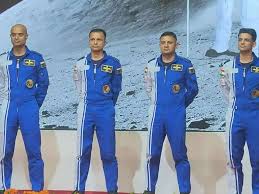
Institutionally, the programme has strong backing. The four astronauts—Shubhanshu Shukla, Prasanth Nair, Ajit Krishnan, and Angad Pratap—are training intensively in simulators, centrifuges, and survival environments. ISRO has also coordinated with the Indian Navy for recovery rehearsals. International partnerships with CNES (France) and others support medical monitoring and training.
Financially, the government has reaffirmed its commitment. The budget outlay has been revised upward to ₹20,193 crore (about $2.3 billion), covering the extended scope of multiple uncrewed tests and system redundancies. Compared to the global average cost of human spaceflight, India’s programme remains highly cost-effective, but funding pressures exist given the complexity of first-time technologies.
The roadmap is now firm:
• G1 (uncrewed) in December 2025.
• G2 and G3 (further uncrewed flights) during 2026, testing longer durations and more subsystems.
• G4 (crewed) in early 2027—three astronauts into orbit for about three days.
With many subsystems validated, Gaganyaan is closer than ever to liftoff. The risks are real, but so is the momentum.
Upcoming Missions and Next Steps
The immediate next step, Gaganyaan-1, will be a crucial systems-check mission. If it validates the ECLSS, avionics, thermal protection, and recovery operations, it will clear the way for more ambitious uncrewed flights. These later missions will test pressurised modules in space, simulate longer stays, and evaluate human-in-the-loop systems.
Vyomitra will continue to play a starring role in uncrewed flights. Equipped with sensors and limited AI, the humanoid can simulate physiological responses and interact with mission control. While symbolic, Vyomitra’s role is practical—it helps validate conditions before risking human lives.
By 2026, ISRO plans at least two more test flights. These will trial advanced abort modes, service module propulsion, and endurance of systems. Only after these are successful will astronauts fly. The first crewed mission, Gaganyaan-4, is targeted for Q1 2027. The crew is expected to spend about 3 days in LEO at 400 km altitude, conducting basic microgravity experiments before re-entering over the Indian Ocean.
Beyond Gaganyaan itself, the programme sets the stage for the next decade. The technology base being created will feed directly into the Bharatiya Antariksh Station, planned for assembly by 2035. It will also strengthen India’s readiness for participation in Artemis or other lunar initiatives. In short, Gaganyaan is not an end—it is a beginning.
Challenges & Risks Ahead
Human spaceflight is inherently risky, and Gaganyaan is no exception. Several challenges lie ahead:
• Safety Systems: The crew escape system must perform flawlessly under all scenarios—pad abort, in-flight abort, high-altitude abort. Multiple live tests remain.
• Life Support: India has never built a closed ECLSS before. Ensuring stable oxygen, CO₂ scrubbing, and humidity control in orbit is a first.
• Parachutes & Recovery: Splashdowns are complex, involving multi-stage parachutes, capsule upright procedures, and naval recovery.
• Delays & Dependencies: Even a small failure—say, a faulty pyro-bolt or avionics glitch—can push timelines back months.
• Budget & Resource Pressures: At ₹20,000+ crore, the mission is already expensive. Further overruns could invite scrutiny.
• Human Factors: Astronaut health and psychology, space medicine, and emergency preparedness are untested in Indian conditions.
ISRO’s cautious, incremental strategy is wise. But the margin for error is thin, and the mission’s credibility hinges on meeting both safety and schedule benchmarks.
Implications for India and the Global Space Arena
A successful Gaganyaan flight will resonate far beyond India’s borders. It will make India the fourth nation with independent human spaceflight capability, after Russia, the U.S., and China.
Domestically, it will strengthen India’s aerospace ecosystem, boosting companies that supply materials, sensors, robotics, and avionics. Many of these spin-offs could impact civilian industries, from medical devices to clean-room technologies.
Diplomatically, it enhances India’s bargaining power in global space partnerships. The experience with Axiom and CNES already shows how Gaganyaan is woven into broader cooperation. Longer term, India’s proposed space station will need international crew exchanges, scientific partnerships, and supply chains.
For society at large, the psychological effect will be immense. Just as Chandrayaan-3’s Moon landing inspired mass pride, Gaganyaan will become a symbol of India’s technological coming of age. Its success could also trigger new investments in space startups, education, and defence applications.
Globally, India’s entry as a human spaceflight power raises competition and collaboration in equal measure. It signals that the 21st-century space race is no longer bipolar, but multipolar.
Readiness, Aspirations, and the Road Ahead
As of August 2025, Gaganyaan stands at the threshold. Nearly seven years of preparation are converging on a December uncrewed launch that could define India’s space trajectory for decades. The systems are in place, the astronauts are in training, and the government has backed the programme with funds and political will.
But challenges remain. Safety systems must be validated, life-support proven, and recovery rehearsed under real conditions. The 2027 crewed launch will be a defining moment, not only for ISRO but for India’s image as a technological power.
If successful, Gaganyaan will not just carry three astronauts into orbit. It will carry the aspirations of 1.4 billion people. It will light the path toward India’s own space station, future lunar missions, and a permanent role in shaping humanity’s destiny in space.
In other words: Gaganyaan is not just about reaching the stars. It is about ensuring that India has a voice in writing the story of space exploration itself.

 NehaScope
What is Gaganyaan and Why It Matters ?
India’s Gaganyaan programme is more than a space mission; it is a statement of intent. At its core, Gaganyaan aims to demonstrate the capability to send Indian astronauts—Gaganyatris—into low Earth orbit (LEO) and return them safely. For a country that has already mastered complex planetary missions like Chandrayaan and Mangalyaan, this leap into human spaceflight is the next logical step. But unlike robotic missions, which can tolerate higher risks, human spaceflight demands perfection. Every system, from propulsion to life support, must work flawlessly.
The rationale goes beyond prestige. Human spaceflight consolidates India’s technological self-reliance. It forces breakthroughs in materials, robotics, avionics, communication, medicine, and environmental control. These technologies, once mastered, can spin off into civilian industries, from healthcare to disaster management. The programme also ties into larger ambitions: an Indian space station by 2035, a crewed lunar landing by 2040, and deeper participation in international exploration initiatives.
Equally important is the programme’s inspirational power. Just as Apollo fired imaginations in the 1960s, Gaganyaan could inspire a new generation of Indian students to take up science, technology, and engineering. It places India in the select club of nations—currently only the U.S., Russia, and China—that have independently flown humans to space. For a rising global power, that positioning is not cosmetic; it is strategic.
As of August 2025, the programme is at a critical juncture. Years of design, testing, and training are converging toward the first big step: the uncrewed Gaganyaan-1 mission scheduled for December this year. Success there will set the stage for India’s first astronauts in orbit by early 2027.
Key Milestones So Far
When Prime Minister Narendra Modi formally announced Gaganyaan on August 15, 2018, the original goal was ambitious: to send Indians to space by 2022, marking 75 years of independence. The intervening years, however, brought challenges. The COVID-19 pandemic slowed work. Supply-chain issues delayed components. ISRO also chose the path of extreme caution, building in additional safety tests and uncrewed missions to minimise risk.
In these seven years, India has built a formidable foundation. The LVM3 rocket—already proven in satellite launches—has been human-rated for reliability. The crew escape system, which must save astronauts in the event of a launch emergency, has undergone pad abort and static fire tests. The Environmental Control and Life Support System (ECLSS), which will maintain cabin pressure, oxygen, and humidity, has been designed indigenously. Perhaps most visibly, Vyomitra, a semi-humanoid robot, was unveiled as a test passenger for uncrewed flights.
Infrastructure has also expanded. A crew training facility has been set up in Bengaluru. The Satish Dhawan Space Centre in Sriharikota has been modified with emergency egress facilities and medical support. Recovery teams, including the Navy and Coast Guard, have rehearsed capsule retrieval from the sea.
India has also gained valuable experience through international exposure. Four Air Force test pilots were selected as astronaut-candidates in 2020, trained in Russia, and are now continuing mission-specific training at home. More recently, Wing Commander Shubhanshu Shukla’s participation in the Axiom-4 mission to the ISS gave India its first taste of human space operations in a global context.
The timeline has shifted, but the progression is clear: develop systems, validate them on the ground, fly them uncrewed, and only then carry humans. This “safety first” approach means India is slower than initially planned—but also better prepared.
Current Status : Technical, Institutional, Financial
Gaganyaan today is entering its decisive phase. The most important milestone ahead is Gaganyaan-1 (G1), an uncrewed flight scheduled for December 2025. It will carry Vyomitra along with a payload of sensors to validate systems in orbit.
On the technical front, several successes stand out. Earlier this year, ISRO completed an Integrated Air-Drop Test in which a five-tonne dummy crew module was dropped from a helicopter. The parachutes deployed in sequence, demonstrating safe splashdown capability. The human-rated LVM3 has passed multiple static tests. Thermal protection tiles, avionics, and the crew module’s service section have been qualified for spaceflight. Life-support prototypes are undergoing ground trials.
Institutionally, the programme has strong backing. The four astronauts—Shubhanshu Shukla, Prasanth Nair, Ajit Krishnan, and Angad Pratap—are training intensively in simulators, centrifuges, and survival environments. ISRO has also coordinated with the Indian Navy for recovery rehearsals. International partnerships with CNES (France) and others support medical monitoring and training.
Financially, the government has reaffirmed its commitment. The budget outlay has been revised upward to ₹20,193 crore (about $2.3 billion), covering the extended scope of multiple uncrewed tests and system redundancies. Compared to the global average cost of human spaceflight, India’s programme remains highly cost-effective, but funding pressures exist given the complexity of first-time technologies.
The roadmap is now firm:
• G1 (uncrewed) in December 2025.
• G2 and G3 (further uncrewed flights) during 2026, testing longer durations and more subsystems.
• G4 (crewed) in early 2027—three astronauts into orbit for about three days.
With many subsystems validated, Gaganyaan is closer than ever to liftoff. The risks are real, but so is the momentum.
Upcoming Missions and Next Steps
The immediate next step, Gaganyaan-1, will be a crucial systems-check mission. If it validates the ECLSS, avionics, thermal protection, and recovery operations, it will clear the way for more ambitious uncrewed flights. These later missions will test pressurised modules in space, simulate longer stays, and evaluate human-in-the-loop systems.
Vyomitra will continue to play a starring role in uncrewed flights. Equipped with sensors and limited AI, the humanoid can simulate physiological responses and interact with mission control. While symbolic, Vyomitra’s role is practical—it helps validate conditions before risking human lives.
By 2026, ISRO plans at least two more test flights. These will trial advanced abort modes, service module propulsion, and endurance of systems. Only after these are successful will astronauts fly. The first crewed mission, Gaganyaan-4, is targeted for Q1 2027. The crew is expected to spend about 3 days in LEO at 400 km altitude, conducting basic microgravity experiments before re-entering over the Indian Ocean.
Beyond Gaganyaan itself, the programme sets the stage for the next decade. The technology base being created will feed directly into the Bharatiya Antariksh Station, planned for assembly by 2035. It will also strengthen India’s readiness for participation in Artemis or other lunar initiatives. In short, Gaganyaan is not an end—it is a beginning.
Challenges & Risks Ahead
Human spaceflight is inherently risky, and Gaganyaan is no exception. Several challenges lie ahead:
• Safety Systems: The crew escape system must perform flawlessly under all scenarios—pad abort, in-flight abort, high-altitude abort. Multiple live tests remain.
• Life Support: India has never built a closed ECLSS before. Ensuring stable oxygen, CO₂ scrubbing, and humidity control in orbit is a first.
• Parachutes & Recovery: Splashdowns are complex, involving multi-stage parachutes, capsule upright procedures, and naval recovery.
• Delays & Dependencies: Even a small failure—say, a faulty pyro-bolt or avionics glitch—can push timelines back months.
• Budget & Resource Pressures: At ₹20,000+ crore, the mission is already expensive. Further overruns could invite scrutiny.
• Human Factors: Astronaut health and psychology, space medicine, and emergency preparedness are untested in Indian conditions.
ISRO’s cautious, incremental strategy is wise. But the margin for error is thin, and the mission’s credibility hinges on meeting both safety and schedule benchmarks.
Implications for India and the Global Space Arena
A successful Gaganyaan flight will resonate far beyond India’s borders. It will make India the fourth nation with independent human spaceflight capability, after Russia, the U.S., and China.
Domestically, it will strengthen India’s aerospace ecosystem, boosting companies that supply materials, sensors, robotics, and avionics. Many of these spin-offs could impact civilian industries, from medical devices to clean-room technologies.
Diplomatically, it enhances India’s bargaining power in global space partnerships. The experience with Axiom and CNES already shows how Gaganyaan is woven into broader cooperation. Longer term, India’s proposed space station will need international crew exchanges, scientific partnerships, and supply chains.
For society at large, the psychological effect will be immense. Just as Chandrayaan-3’s Moon landing inspired mass pride, Gaganyaan will become a symbol of India’s technological coming of age. Its success could also trigger new investments in space startups, education, and defence applications.
Globally, India’s entry as a human spaceflight power raises competition and collaboration in equal measure. It signals that the 21st-century space race is no longer bipolar, but multipolar.
Readiness, Aspirations, and the Road Ahead
As of August 2025, Gaganyaan stands at the threshold. Nearly seven years of preparation are converging on a December uncrewed launch that could define India’s space trajectory for decades. The systems are in place, the astronauts are in training, and the government has backed the programme with funds and political will.
But challenges remain. Safety systems must be validated, life-support proven, and recovery rehearsed under real conditions. The 2027 crewed launch will be a defining moment, not only for ISRO but for India’s image as a technological power.
If successful, Gaganyaan will not just carry three astronauts into orbit. It will carry the aspirations of 1.4 billion people. It will light the path toward India’s own space station, future lunar missions, and a permanent role in shaping humanity’s destiny in space.
In other words: Gaganyaan is not just about reaching the stars. It is about ensuring that India has a voice in writing the story of space exploration itself.
Share this: