On Paper Bags Day, let’s talk about plastic, science and the sacred animals we’re silently killing.
The Indian Street Scene: A Dangerous Mix
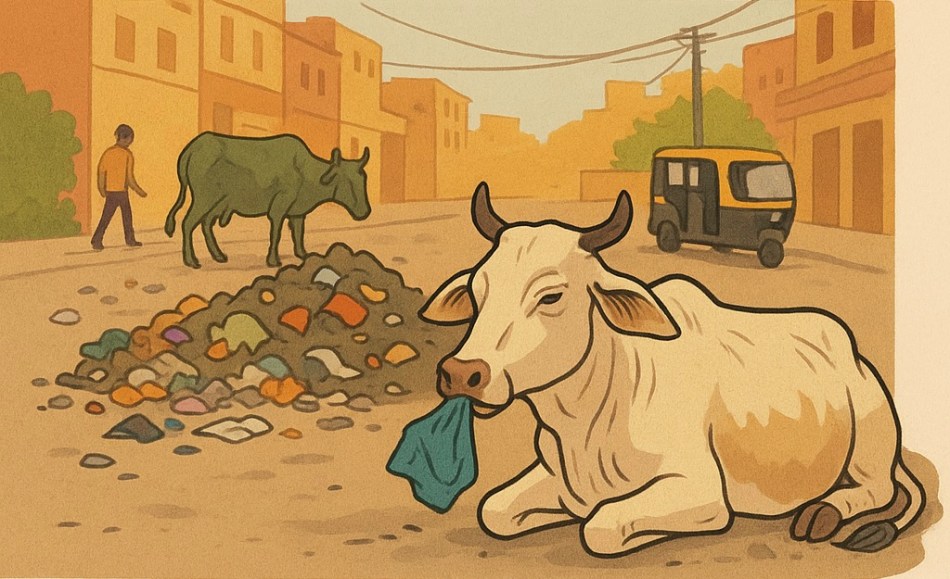
In almost every Indian town, there’s a familiar sight – cows wandering freely, often feeding near garbage heaps. For many, these cows are sacred. For others, they are part of the street ecosystem. But here’s what’s rarely talked about: Our cows are not just eating leftover chapatis – they’re eating plastic bags, wrappers, and garbage soaked in food. And it’s killing them slowly.
What Happens When a Cow Eats Plastic?
This is not just a visual problem — it is a biological disaster inside the cow’s body.
Cows are ruminants, animals with a four-chambered stomach designed to digest plant fibre. The first and largest chamber is the rumen, where microbial fermentation breaks down grasses, crop residue, and natural fodder.
But when a cow eats plastic bags, food wrappers, or synthetic waste mixed in garbage, here’s what really happens inside:
1. Plastic Gets Trapped in the Rumen
- The rumen cannot break down synthetic materials like polyethylene (the main component in plastic bags).
- These plastics do not move forward in the digestive process and start accumulating.
- Over time, dozens of bags can clump into a dense, solid mass — like a plastic brick inside the stomach.
2. Digestive Blockages and Bloating
• The trapped plastic blocks the natural movement of digested material to the intestines.
- This leads to ruminal tympany, or bloating, caused by gas buildup.
- The cow suffers from pain, restlessness, and swelling of the left abdomen, often mistaken for overeating.
3. Nutrient Absorption Stops
• Even if the cow continues eating, the presence of plastic prevents absorption of nutrients in the gut.
• The animal gradually develops weakness, anaemia, and muscle loss.
• It may appear to eat, but internal starvation begins.
4. Toxic Leach and Inflammation
• Many plastic bags contain chemical dyes, food stains, or pesticide residues.
• These leach into the rumen environment, triggering inflammation, ulcers, and microbial imbalance.
• Plastic can also cause intestinal perforation if sharp edges pierce the lining.
5. Long-Term Systemic Effects
• Liver and kidney functions decline due to chronic exposure to ingested toxins.
• Immunity weakens, making the cow vulnerable to infections.
• The cow may develop a condition known as “Plastic Rumen Syndrome”, a term now used in veterinary clinics across India.
A Slow, Painful Death
The tragedy of plastic ingestion in cows is not always immediate. In fact, that is what makes it even more cruel, the damage is slow, hidden, and relentless.
The Illusion of Health
- Cows are stoic animals. They continue to graze, chew cud, and walk the streets — giving a false appearance of wellness.
- Families or owners often don’t recognize internal symptoms until it’s too late.
- During this period, the cow suffers chronic indigestion, gas buildup, dehydration, and extreme discomfort.
Silent Suffering
The cow may experience:
• Extreme fatigue
• Reduced milk production
• Swollen abdomen
• Painful bloat (ruminal tympany)
But these signs are often ignored in stray animals or misattributed to aging or malnutrition. Unlike sharp injuries, there’s no bleeding or limping — only an internal breakdown of systems.
The Costly and Risky Surgery
- When the cow collapses or stops eating altogether, veterinary help is sought, often as a last resort.
- An emergency rumenotomy (surgical opening of the rumen) is performed to manually remove the plastic.
This involves:
• Sedating the cow
• Opening the left flank
• Extracting bundles of plastic, cloth, ropes, and food waste
• Recovery is long and survival is not guaranteed — especially in weak or older animals.
• In rural areas, access to such advanced veterinary care is rare or unaffordable.
Economic Fallout
- For small dairy farmers, a cow that stops producing milk is considered “non-productive”.
- Instead of treatment, many owners abandon the animal, fearing medical expenses or legal penalties (especially in states with cow protection laws).
- The animal ends up on the street, weak, infected, and eventually dies in the open — often near the same garbage that killed it.
The Death Nobody Notices
- Municipal reports do not count plastic ingestion as a formal cause of cattle death — it remains undocumented.
- The cow’s carcass is removed and buried or incinerated without analysis.
- The cycle continues — garbage remains open, plastic remains accessible, and another cow begins chewing on leftover food wrapped in plastic.
It is Not Just About a Bag, It is About a System
That one plastic bag given at a shop, used for 5 minutes, may stay inside a cow for years – causing pain, starvation, and death. Replacing it with a paper bag may seem small — but it’s a biological intervention that could save a life. This is not just an act of environmentalism. It is an act of science-rooted compassion.
Real Data: The Scale of the Crisis
- According to a study by Punjab Veterinary University, 62% of stray cattle examined had ingested plastic, with some containing more than 30 kg in their rumen.
- In Delhi’s veterinary hospitals, more than 70% of cow surgeries are now related to plastic ingestion.
- The IVRI (Indian Veterinary Research Institute) has formally recommended strict action on plastic waste as an animal welfare issue.
What the Studies Show: Plastic Kills Silently, But the Numbers Speak Loudly
1. 50 Kilograms of Plastic — In One Cow
- A study by the Indian Veterinary Research Institute (IVRI), Bareilly, documented cases where up to 50 kg of plastic waste — including carry bags, food wrappers, and garbage , was surgically removed from the rumen of a single stray cow.
- In one case, a cow was found to have ingested over 120 plastic bags, some as old as 5 years, layered and stuck together.
2. Urban India: Where the Problem Is Worst
- In Delhi, veterinary hospitals report hundreds of cow deaths every year directly linked to plastic ingestion.
- In Mumbai, a survey by the Bombay Veterinary College found that every second stray cow brought in for surgery had plastic inside its digestive tract.
- In Bangalore, the Animal Husbandry Department noted that more than 70% of post-mortems on urban cattle revealed plastic blockage as the primary cause of death.
3. Plastic Bags Soaked in Food: The Real Bait
- Research from the Punjab Agricultural University (PAU) found that 98% of plastic ingested by stray cattle came from discarded food packaging — such as polythene bags, biscuit wrappers, and leftover meal containers.
- These plastics are soaked in oil, gravy, or stale food — making them smell edible, thus luring animals to eat them.
- Unlike dry wrappers, food-smeared plastic is more likely to be eaten and swallowed whole, especially when animals are hungry and desperate.
4. Cumulative Damage: It’s Not Just One Bag
• Scientists at Kerala Veterinary and Animal Sciences University (KVASU) highlighted that even repeated ingestion of small plastic pieces (microplastics) over time leads to:
• Severe malnutrition
• Altered gut microbiota (the cow’s natural digestive bacteria)
• Reproductive failure in female cattle
This is a long-term health crisis — not just for cows, but for dairy productivity and food safety.
5. No National Database = No National Action
- India does not yet maintain a centralised record of animal deaths caused by plastic ingestion.
- Most such cases are handled at local veterinary hospitals and go unreported in official statistics.
- This lack of data leads to policy blindness, where plastic bans focus on aesthetics, not on the invisible toll on animals.
It is not just the Cow, It is the Chain
When a cow eats plastic, the damage doesn’t end with her. It travels through the economy, the food system, and even into our bodies.
1. Dairy Farmers: The First to Suffer
- A cow that eats plastic regularly becomes lethargic, bloated, and chronically ill.
- This leads to a sharp drop in milk production, sometimes by 30–50%.
- In serious cases, the cow stops eating altogether and may become infertile, making her unfit for breeding.
- Treatment — if attempted — requires expensive surgery, costing ₹10,000–₹25,000, which most small farmers cannot afford.
- End result: the cow is abandoned, and the farmer suffers a loss of income, labour, and investment.
In states like Rajasthan, Gujarat, and U.P., where small-scale dairy farming supports rural households, this becomes a rural economic issue, not just an animal issue.
2. Consumers: Plastic May Enter the Milk Chain
- When plastic accumulates in the cow’s stomach, it leads to:
- Toxin release from chemical-laden plastics (especially coloured or food-contaminated plastics)
• Gut inflammation and tissue damage
• Leaching of microplastics and harmful residues into the bloodstream
• These substances can bioaccumulate in milk and organs over time.
While formal studies in India are still limited, global research shows:
- Phthalates and bisphenols (from plastics) can pass into animal products like milk and meat.
- These compounds are known endocrine disruptors, linked to hormonal imbalance, infertility, and developmental disorders in humans.
What goes into the cow eventually reaches the consumer — making this a food safety concern.
3. Other Animals: Plastic Spares No Species
Cows aren’t the only victims of plastic ingestion:
- Street dogs are commonly seen chewing on food waste wrapped in plastic, leading to intestinal obstructions and death.
- Goats and sheep, especially in rural grazing areas near waste dumps, ingest plastic that damages their delicate digestive systems.
- Birds, including crows and kites, feed on garbage heaps and swallow plastic films and threads while picking food scraps.
In some urban gaushalas and rescue centres, post-mortems have revealed plastic in 80% of dead stray animals, across species.
This is a multi-species environmental disaster in slow motion.
4. Public Health: The Invisible Threat
- Burning of collected plastic waste (including bags eaten and later excreted by animals) releases toxic fumes such as dioxins and furans.
- These are carcinogenic compounds known to cause respiratory problems, skin diseases, and immune dysfunction.
- Unchecked plastic pollution also:
• Contaminates groundwater near dumpsites
- Reduces soil fertility when plastic enters the compost chain
- Increases risk of zoonotic diseases due to open garbage attracting animals and vectors like flies and rodents
So the cycle doesn’t just begin and end with a cow, it touches human lungs, food, water, and livelihoods.
This issue must be reframed — from “protect the cow” to “protect the chain.”
Because:
• It starts with a single plastic bag,
• But ends in a broken food system,
• Affecting farmers, families, and the environment — across caste, class, and species.
This is a One Health crisis — where animal, human, and ecosystem health are deeply intertwined.
Enter the Paper Bag: A Life-Saving Alternative
Paper bags, unlike plastic, decompose naturally and don’t choke animals — even if accidentally eaten.
The Science of Paper Bags:
• Made from plant cellulose (wood pulp, agri-waste), they break down in 4–6 weeks.
• They contain no synthetic polymers, dyes, or toxins harmful to animals or soil.
• Even if ingested, small quantities pass through the digestive tract without damage.
One shopkeeper switching from plastic to paper bags could mean hundreds of plastic bags less on the street each month — and one less cow in pain.
What You Can Do ?
Even small actions can protect a cow’s life. Here’s how you can help:
- Refuse plastic bags, even if they’re free — carry a paper or cloth bag instead.
- Report garbage piles near temples, dairies, and street food zones — these are plastic hotspots for animals.
- Talk to shopkeepers — when more customers ask, many willingly switch to paper bags.
- Host paper bag drives in schools, colleges, or panchayats using old newspapers.
- Support your local ban on plastic bags — and remind others it’s about saving lives, not just rules.
- Click and share images of plastic-free shops or paper bag users to inspire others.
One less plastic bag. One saved life. It begins with you.
A Bag with a Heart
One paper bag may seem like a small thing. But in a country with 5 million stray cattle, that one bag can be the difference between:
• Life and a slow death
• Nourishment and starvation
• Respect and neglect
This Paper Bags Day, don’t just celebrate an eco-friendly material.
Celebrate a conscious act of compassion, backed by science and rooted in Indian streets.
Because saving the planet is great – But saving a cow’s life? That is something sacred.

 NehaScope
On Paper Bags Day, let’s talk about plastic, science and the sacred animals we’re silently killing.
The Indian Street Scene: A Dangerous Mix
In almost every Indian town, there’s a familiar sight – cows wandering freely, often feeding near garbage heaps. For many, these cows are sacred. For others, they are part of the street ecosystem. But here’s what’s rarely talked about: Our cows are not just eating leftover chapatis – they’re eating plastic bags, wrappers, and garbage soaked in food. And it’s killing them slowly.
What Happens When a Cow Eats Plastic?
This is not just a visual problem — it is a biological disaster inside the cow’s body.
Cows are ruminants, animals with a four-chambered stomach designed to digest plant fibre. The first and largest chamber is the rumen, where microbial fermentation breaks down grasses, crop residue, and natural fodder.
But when a cow eats plastic bags, food wrappers, or synthetic waste mixed in garbage, here’s what really happens inside:
1. Plastic Gets Trapped in the Rumen
2. Digestive Blockages and Bloating
• The trapped plastic blocks the natural movement of digested material to the intestines.
3. Nutrient Absorption Stops
• Even if the cow continues eating, the presence of plastic prevents absorption of nutrients in the gut.
• The animal gradually develops weakness, anaemia, and muscle loss.
• It may appear to eat, but internal starvation begins.
4. Toxic Leach and Inflammation
• Many plastic bags contain chemical dyes, food stains, or pesticide residues.
• These leach into the rumen environment, triggering inflammation, ulcers, and microbial imbalance.
• Plastic can also cause intestinal perforation if sharp edges pierce the lining.
5. Long-Term Systemic Effects
• Liver and kidney functions decline due to chronic exposure to ingested toxins.
• Immunity weakens, making the cow vulnerable to infections.
• The cow may develop a condition known as “Plastic Rumen Syndrome”, a term now used in veterinary clinics across India.
A Slow, Painful Death
The tragedy of plastic ingestion in cows is not always immediate. In fact, that is what makes it even more cruel, the damage is slow, hidden, and relentless.
The Illusion of Health
But these signs are often ignored in stray animals or misattributed to aging or malnutrition. Unlike sharp injuries, there’s no bleeding or limping — only an internal breakdown of systems.
The Costly and Risky Surgery
This involves:
• Sedating the cow
• Opening the left flank
• Extracting bundles of plastic, cloth, ropes, and food waste
• Recovery is long and survival is not guaranteed — especially in weak or older animals.
• In rural areas, access to such advanced veterinary care is rare or unaffordable.
Economic Fallout
The Death Nobody Notices
It is Not Just About a Bag, It is About a System
That one plastic bag given at a shop, used for 5 minutes, may stay inside a cow for years – causing pain, starvation, and death. Replacing it with a paper bag may seem small — but it’s a biological intervention that could save a life. This is not just an act of environmentalism. It is an act of science-rooted compassion.
Real Data: The Scale of the Crisis
What the Studies Show: Plastic Kills Silently, But the Numbers Speak Loudly
1. 50 Kilograms of Plastic — In One Cow
2. Urban India: Where the Problem Is Worst
3. Plastic Bags Soaked in Food: The Real Bait
4. Cumulative Damage: It’s Not Just One Bag
• Scientists at Kerala Veterinary and Animal Sciences University (KVASU) highlighted that even repeated ingestion of small plastic pieces (microplastics) over time leads to:
• Severe malnutrition
• Altered gut microbiota (the cow’s natural digestive bacteria)
• Reproductive failure in female cattle
This is a long-term health crisis — not just for cows, but for dairy productivity and food safety.
5. No National Database = No National Action
It is not just the Cow, It is the Chain
When a cow eats plastic, the damage doesn’t end with her. It travels through the economy, the food system, and even into our bodies.
1. Dairy Farmers: The First to Suffer
In states like Rajasthan, Gujarat, and U.P., where small-scale dairy farming supports rural households, this becomes a rural economic issue, not just an animal issue.
2. Consumers: Plastic May Enter the Milk Chain
• Gut inflammation and tissue damage
• Leaching of microplastics and harmful residues into the bloodstream
• These substances can bioaccumulate in milk and organs over time.
While formal studies in India are still limited, global research shows:
What goes into the cow eventually reaches the consumer — making this a food safety concern.
3. Other Animals: Plastic Spares No Species
Cows aren’t the only victims of plastic ingestion:
In some urban gaushalas and rescue centres, post-mortems have revealed plastic in 80% of dead stray animals, across species.
This is a multi-species environmental disaster in slow motion.
4. Public Health: The Invisible Threat
• Contaminates groundwater near dumpsites
So the cycle doesn’t just begin and end with a cow, it touches human lungs, food, water, and livelihoods.
This issue must be reframed — from “protect the cow” to “protect the chain.”
Because:
Enter the Paper Bag: A Life-Saving Alternative
Paper bags, unlike plastic, decompose naturally and don’t choke animals — even if accidentally eaten.
The Science of Paper Bags:
• Made from plant cellulose (wood pulp, agri-waste), they break down in 4–6 weeks.
• They contain no synthetic polymers, dyes, or toxins harmful to animals or soil.
• Even if ingested, small quantities pass through the digestive tract without damage.
One shopkeeper switching from plastic to paper bags could mean hundreds of plastic bags less on the street each month — and one less cow in pain.
What You Can Do ?
Even small actions can protect a cow’s life. Here’s how you can help:
One less plastic bag. One saved life. It begins with you.
A Bag with a Heart
One paper bag may seem like a small thing. But in a country with 5 million stray cattle, that one bag can be the difference between:
• Life and a slow death
• Nourishment and starvation
• Respect and neglect
This Paper Bags Day, don’t just celebrate an eco-friendly material.
Celebrate a conscious act of compassion, backed by science and rooted in Indian streets.
Because saving the planet is great – But saving a cow’s life? That is something sacred.
Share this: