When we think of Sir C.V. Raman, we often picture the great physicist who won India’s first Nobel Prize in Science for discovering the Raman Effect. But did you know that beyond his groundbreaking work in physics, he was also deeply fascinated by Indian classical music?
Yes! The same man who revealed the secrets of light scattering also spent years studying the science behind sound—specifically, the unique properties of Indian musical instruments. His scientific curiosity extended far beyond laboratories; he sought to understand why Indian instruments produced sounds that were so rich and melodious compared to their Western counterparts.
A Nobel Laureate With a Musical Ear
C.V. Raman was not just a scientist who loved music, he was a scientist who wanted to decode its mysteries. He believed that science and music were deeply connected, and he used his research skills to explore the physics of sound.
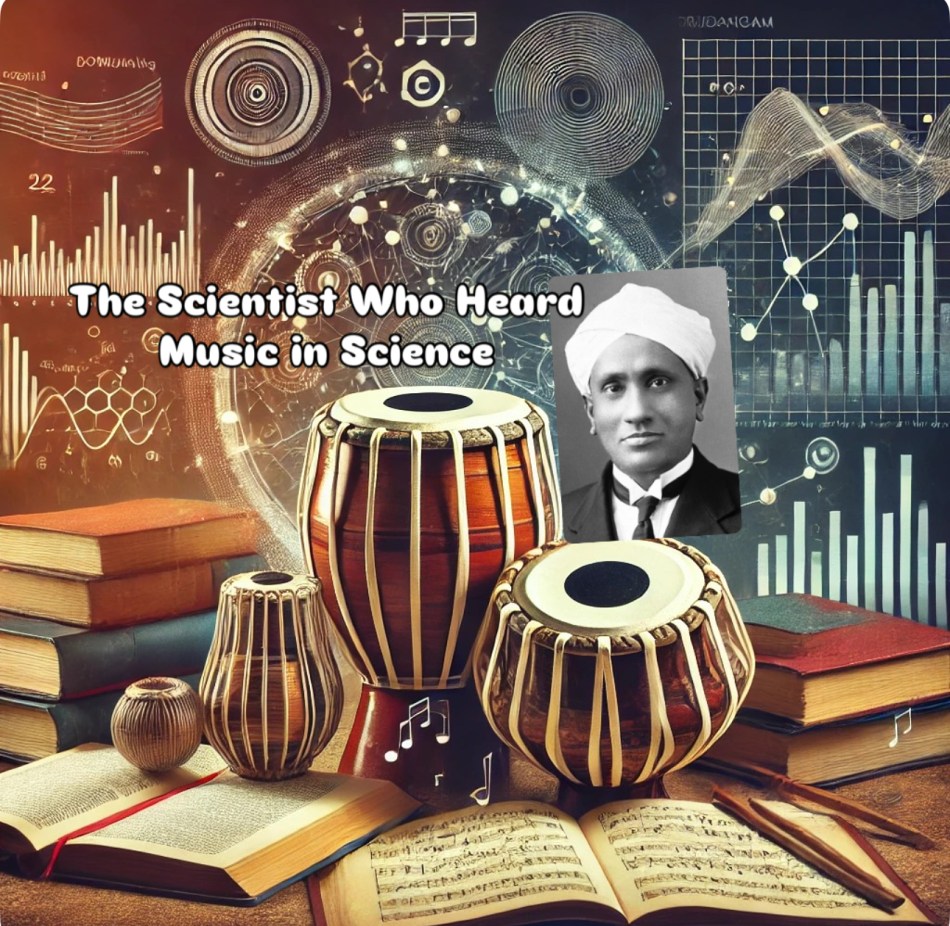
One of his most fascinating studies was on Indian percussion instruments like the mridangam and tabla. These instruments, widely used in Carnatic and Hindustani classical music, produce a variety of overtones, giving them a unique resonance. But why did they sound so different from Western drums?
Raman conducted experiments to find out. He discovered that the Indian drumheads were designed in a way that allowed them to produce multiple harmonics (overtones) simultaneously. This is what gives instruments like the mridangam and tabla their deep, complex sound. His work on the acoustics of musical instruments was so significant that it became a pioneering study in musical physics.
C.V. Raman Built His Own Musical Laboratory
Unlike most scientists who focused solely on physics or chemistry, Raman went a step further—he created a dedicated research lab for musical acoustics at the Indian Association for the Cultivation of Science (IACS), Kolkata. This was where he conducted detailed studies on Indian string and percussion instruments, analyzing their sound quality, resonance, and vibration patterns.
His Research on the Violin’s Sound Quality
Raman was not only interested in Indian instruments but also studied the acoustics of the violin. He compared the tonal quality of Western violins to that of Indian string instruments like the veena and tanpura. His studies helped in understanding why different string instruments produce distinct tonal variations based on their structure and materials.
He Was One of the First to Scientifically Study the Mridangam and Tabla
Before Raman’s research, very little was known about the scientific principles behind the sound of Indian drums like the mridangam and tabla.
– He discovered that the black circular patch (syahi) on the mridangam and tabla is not just a decorative element but plays a critical role in producing harmonic overtones, making them unique compared to Western drums.
– His study of vibrational patterns in percussion instruments is still used in modern acoustics research and musical instrument design.
Raman’s Interest in Music Came from His Family
C.V. Raman came from a family that deeply appreciated music. His father, Chandrasekara Ramanathan Iyer, was a lecturer in physics and mathematics but was also an accomplished veena player. This early exposure to classical music sparked Raman’s lifelong passion for the science of sound.
He Discovered the Physics Behind ‘Blue Diamonds’
Apart from his work in optics and acoustics, Raman also conducted studies on gemstones like diamonds and opals.
– He explained why some diamonds appear blue—it was due to light scattering within the crystal structure, a concept similar to the Raman Effect.
– His findings helped in identifying real diamonds from fake ones, benefiting both scientists and jewellers.
He Used a Simple Experiment to Discover the Raman Effect
Unlike today’s high-tech laser equipment, Raman and his student K.S. Krishnan used a simple sunlight source, a prism, and a homemade spectrograph to conduct the experiment that led to the discovery of the Raman Effect.
– This discovery was so revolutionary that it changed the way scientists study molecular structures and became the foundation for modern Raman Spectroscopy, which is now used in medicine, space science, forensic investigations, and material analysis.
NASA and ISRO Use Raman Spectroscopy Today
Raman’s discovery is so influential that it is now used in space exploration.
– NASA’s Perseverance Rover on Mars is equipped with SHERLOC, a Raman Spectrometer designed to detect signs of ancient life on Mars.
– ISRO is also integrating Raman spectroscopy in moon and planetary missions to analyze surface minerals and detect water molecules.
He Was Almost Denied the Nobel Prize
Although Raman won the Nobel Prize in 1930, there was controversy surrounding his win. Many Western scientists doubted his findings initially because he was an Indian working in a poorly funded lab with basic equipment.
– However, Raman defended his work confidently, and when the Nobel Committee retested his experiments in Europe, they found his discovery to be correct.
– His Nobel Prize win was not just a victory for him but also for Indian science, proving that scientific genius is not limited by geography or resources.
He Declined a Knighthood After India’s Independence
Raman was knighted by the British in 1929, receiving the title “Sir” C.V. Raman. However, after India’s independence in 1947, he stopped using the title and focused entirely on building India’s scientific institutions.
His Final Words Showed His Dedication to Science
In his last days, C.V. Raman remained dedicated to research. Even when he was seriously ill, he continued working in his lab at the Raman Research Institute, Bengaluru.
– Before passing away in 1970, his last words reportedly were: “I wish to continue working with nature’s phenomena till my last breath.”
Why This Matters Today ?
Today, music technology and sound engineering rely heavily on the principles Raman explored nearly a century ago. His work has influenced everything from modern speaker systems to musical instrument design. His studies are still referenced in acoustics research and sound wave analysis.
But beyond the science, his story is a reminder of the importance of curiosity. He didn’t limit himself to one field—he explored everything that fascinated him. His life teaches us that science is not just about formulas and theories—it’s about seeing the wonder in everything, even in music.
More Than a Scientist, A Visionary
C.V. Raman’s legacy goes beyond the Raman Effect. His passion for understanding the mysteries of light, sound, and materials made him a true pioneer. His research on Indian musical instruments, diamonds, and acoustics continues to impact modern science.
Even today, his discoveries are shaping innovations in space, medicine, forensics, and nanotechnology. His story is a powerful reminder that science is not just about formulas—it’s about curiosity, passion, and exploring the unknown.
A Nobel-winning physicist who saw the poetry in music, the science in art, and the wonder in the world around him.
A Legacy That Resonates
As we celebrate National Science Day in his honour, let’s remember not just the physicist, but also the man who listened to the music of the universe. His legacy is not just in textbooks—it’s in every note of a tabla, every strum of a sitar, and every scientific discovery that begins with curiosity.
C.V. Raman didn’t just discover the Raman Effect—he showed the world how science and music sing the same song.

 NehaScope
When we think of Sir C.V. Raman, we often picture the great physicist who won India’s first Nobel Prize in Science for discovering the Raman Effect. But did you know that beyond his groundbreaking work in physics, he was also deeply fascinated by Indian classical music?
Yes! The same man who revealed the secrets of light scattering also spent years studying the science behind sound—specifically, the unique properties of Indian musical instruments. His scientific curiosity extended far beyond laboratories; he sought to understand why Indian instruments produced sounds that were so rich and melodious compared to their Western counterparts.
A Nobel Laureate With a Musical Ear
C.V. Raman was not just a scientist who loved music, he was a scientist who wanted to decode its mysteries. He believed that science and music were deeply connected, and he used his research skills to explore the physics of sound.
One of his most fascinating studies was on Indian percussion instruments like the mridangam and tabla. These instruments, widely used in Carnatic and Hindustani classical music, produce a variety of overtones, giving them a unique resonance. But why did they sound so different from Western drums?
Raman conducted experiments to find out. He discovered that the Indian drumheads were designed in a way that allowed them to produce multiple harmonics (overtones) simultaneously. This is what gives instruments like the mridangam and tabla their deep, complex sound. His work on the acoustics of musical instruments was so significant that it became a pioneering study in musical physics.
C.V. Raman Built His Own Musical Laboratory
Unlike most scientists who focused solely on physics or chemistry, Raman went a step further—he created a dedicated research lab for musical acoustics at the Indian Association for the Cultivation of Science (IACS), Kolkata. This was where he conducted detailed studies on Indian string and percussion instruments, analyzing their sound quality, resonance, and vibration patterns.
His Research on the Violin’s Sound Quality
Raman was not only interested in Indian instruments but also studied the acoustics of the violin. He compared the tonal quality of Western violins to that of Indian string instruments like the veena and tanpura. His studies helped in understanding why different string instruments produce distinct tonal variations based on their structure and materials.
He Was One of the First to Scientifically Study the Mridangam and Tabla
Before Raman’s research, very little was known about the scientific principles behind the sound of Indian drums like the mridangam and tabla.
– He discovered that the black circular patch (syahi) on the mridangam and tabla is not just a decorative element but plays a critical role in producing harmonic overtones, making them unique compared to Western drums.
– His study of vibrational patterns in percussion instruments is still used in modern acoustics research and musical instrument design.
Raman’s Interest in Music Came from His Family
C.V. Raman came from a family that deeply appreciated music. His father, Chandrasekara Ramanathan Iyer, was a lecturer in physics and mathematics but was also an accomplished veena player. This early exposure to classical music sparked Raman’s lifelong passion for the science of sound.
He Discovered the Physics Behind ‘Blue Diamonds’
Apart from his work in optics and acoustics, Raman also conducted studies on gemstones like diamonds and opals.
– He explained why some diamonds appear blue—it was due to light scattering within the crystal structure, a concept similar to the Raman Effect.
– His findings helped in identifying real diamonds from fake ones, benefiting both scientists and jewellers.
He Used a Simple Experiment to Discover the Raman Effect
Unlike today’s high-tech laser equipment, Raman and his student K.S. Krishnan used a simple sunlight source, a prism, and a homemade spectrograph to conduct the experiment that led to the discovery of the Raman Effect.
– This discovery was so revolutionary that it changed the way scientists study molecular structures and became the foundation for modern Raman Spectroscopy, which is now used in medicine, space science, forensic investigations, and material analysis.
NASA and ISRO Use Raman Spectroscopy Today
Raman’s discovery is so influential that it is now used in space exploration.
– NASA’s Perseverance Rover on Mars is equipped with SHERLOC, a Raman Spectrometer designed to detect signs of ancient life on Mars.
– ISRO is also integrating Raman spectroscopy in moon and planetary missions to analyze surface minerals and detect water molecules.
He Was Almost Denied the Nobel Prize
Although Raman won the Nobel Prize in 1930, there was controversy surrounding his win. Many Western scientists doubted his findings initially because he was an Indian working in a poorly funded lab with basic equipment.
– However, Raman defended his work confidently, and when the Nobel Committee retested his experiments in Europe, they found his discovery to be correct.
– His Nobel Prize win was not just a victory for him but also for Indian science, proving that scientific genius is not limited by geography or resources.
He Declined a Knighthood After India’s Independence
Raman was knighted by the British in 1929, receiving the title “Sir” C.V. Raman. However, after India’s independence in 1947, he stopped using the title and focused entirely on building India’s scientific institutions.
His Final Words Showed His Dedication to Science
In his last days, C.V. Raman remained dedicated to research. Even when he was seriously ill, he continued working in his lab at the Raman Research Institute, Bengaluru.
– Before passing away in 1970, his last words reportedly were: “I wish to continue working with nature’s phenomena till my last breath.”
Why This Matters Today ?
Today, music technology and sound engineering rely heavily on the principles Raman explored nearly a century ago. His work has influenced everything from modern speaker systems to musical instrument design. His studies are still referenced in acoustics research and sound wave analysis.
But beyond the science, his story is a reminder of the importance of curiosity. He didn’t limit himself to one field—he explored everything that fascinated him. His life teaches us that science is not just about formulas and theories—it’s about seeing the wonder in everything, even in music.
More Than a Scientist, A Visionary
C.V. Raman’s legacy goes beyond the Raman Effect. His passion for understanding the mysteries of light, sound, and materials made him a true pioneer. His research on Indian musical instruments, diamonds, and acoustics continues to impact modern science.
Even today, his discoveries are shaping innovations in space, medicine, forensics, and nanotechnology. His story is a powerful reminder that science is not just about formulas—it’s about curiosity, passion, and exploring the unknown.
A Nobel-winning physicist who saw the poetry in music, the science in art, and the wonder in the world around him.
A Legacy That Resonates
As we celebrate National Science Day in his honour, let’s remember not just the physicist, but also the man who listened to the music of the universe. His legacy is not just in textbooks—it’s in every note of a tabla, every strum of a sitar, and every scientific discovery that begins with curiosity.
C.V. Raman didn’t just discover the Raman Effect—he showed the world how science and music sing the same song.
Share this: