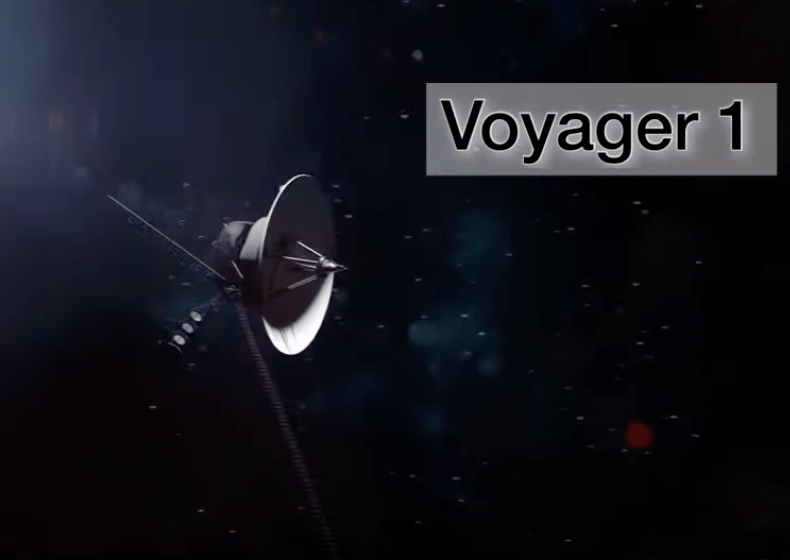
On June 13, 2024, we received exclusive images from none other than NASA’s Voyager 1, a spacecraft that’s been journeying through space for the last 47 years. Launched in 1977, Voyager 1 has ventured farther than any other human-made object—it’s now almost 15 billion miles away from Earth! After operating smoothly for over 46 years, Voyager 1 encountered an issue in November 2023, sending back abnormal data. NASA scientists were puzzled by this anomaly and worked relentlessly to identify and fix the problem. They sent new commands to the spacecraft, which took about 22.5 hours to reach it, and another 22.5 hours to receive a response. The team at NASA’s Jet Propulsion Laboratory discovered that a faulty chip had caused the data transmission to cease. Through an effective coding fix, they mitigated the memory issues in the 47-year-old computer systems. Soon after, Voyager 1 resumed sending accurate signals, confirming its healthy status and readiness to continue its mission. This remarkable achievement has allowed Voyager 1 to once again send valuable data from the depths of space, reinforcing our understanding of the universe. The spacecraft took its last photograph, the famous “Solar System Family Portrait,” in 1990 before its cameras were turned off to conserve energy and memory for crucial particle detection instruments in interstellar space. Scientists hope Voyager 1 will continue to send scientific data until 2025, and possibly up to 2030. Its radioisotope thermoelectric generators (RTGs) may even provide enough power to transmit engineering data until 2036. From 1977 to 1980, Voyager 1’s mission was to explore Jupiter and Saturn and their moons. Upon completing this task, the spacecraft continued its journey into the far reaches of space, now providing NASA with invaluable information about the boundary region of our solar system and interstellar space. Join us as we explore the incredible journey of Voyager 1, a testament to human ingenuity and our quest to uncover the mysteries of the cosmos. Don’t forget to like, subscribe, and hit the notification bell for more amazing space updates! 🚀🔭✨

 NehaScope
On June 13, 2024, we received exclusive images from none other than NASA’s Voyager 1, a spacecraft that’s been journeying through space for the last 47 years. Launched in 1977, Voyager 1 has ventured farther than any other human-made object—it’s now almost 15 billion miles away from Earth! After operating smoothly for over 46 years, Voyager 1 encountered an issue in November 2023, sending back abnormal data. NASA scientists were puzzled by this anomaly and worked relentlessly to identify and fix the problem. They sent new commands to the spacecraft, which took about 22.5 hours to reach it, and another 22.5 hours to receive a response. The team at NASA’s Jet Propulsion Laboratory discovered that a faulty chip had caused the data transmission to cease. Through an effective coding fix, they mitigated the memory issues in the 47-year-old computer systems. Soon after, Voyager 1 resumed sending accurate signals, confirming its healthy status and readiness to continue its mission. This remarkable achievement has allowed Voyager 1 to once again send valuable data from the depths of space, reinforcing our understanding of the universe. The spacecraft took its last photograph, the famous “Solar System Family Portrait,” in 1990 before its cameras were turned off to conserve energy and memory for crucial particle detection instruments in interstellar space. Scientists hope Voyager 1 will continue to send scientific data until 2025, and possibly up to 2030. Its radioisotope thermoelectric generators (RTGs) may even provide enough power to transmit engineering data until 2036. From 1977 to 1980, Voyager 1’s mission was to explore Jupiter and Saturn and their moons. Upon completing this task, the spacecraft continued its journey into the far reaches of space, now providing NASA with invaluable information about the boundary region of our solar system and interstellar space. Join us as we explore the incredible journey of Voyager 1, a testament to human ingenuity and our quest to uncover the mysteries of the cosmos. Don’t forget to like, subscribe, and hit the notification bell for more amazing space updates! 🚀🔭✨
Share this: